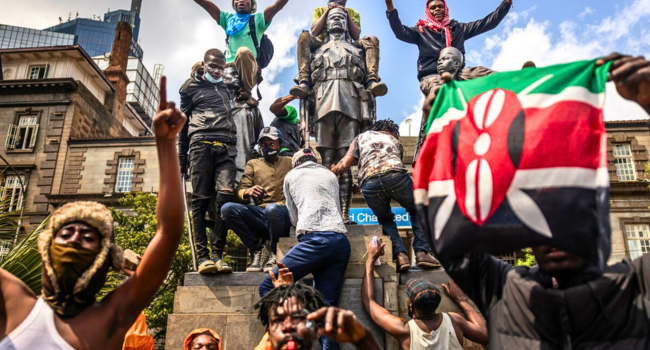
On the first anniversary of Kenya’s anti-government protests, violent clashes erupted on Wednesday, leading to the deaths of two individuals and numerous injuries in Nairobi and other towns across the country. The protests, originally organized to commemorate the anniversary of last year’s mass demonstrations, quickly descended into chaos, as protesters and security forces clashed throughout the day.
Thousands gathered in central Nairobi, including families of victims from the previous year’s protests, which resulted in the deaths of at least 60 individuals. The protests initially began peacefully, with demonstrators marching through the streets, but tensions soon escalated as protesters began throwing projectiles at security forces and calling for the resignation of President William Ruto.
“We are marching against police brutality, against oppression by the government, against high taxation, everything that is going wrong in this country,” said a protester named Anthony, 25, who was also selling flags at the event. He did not wish to provide his full name.
In Matuu, a town 100 kilometres from Nairobi, two individuals were fatally shot by police, according to a hospital official, while local media reported that the protesters had been shot during the clashes. In Nairobi, at least one police officer and several protesters were injured during the demonstrations, and a man suspected of being a plainclothes officer was manhandled by the crowd.
As the protests grew, the government responded by blocking access to live broadcasts of the events. In a statement, the government ordered TV and radio stations to halt live coverage, and NetBlocks, a global internet monitoring group, reported that access to the social media platform Telegram was restricted.
The anniversary marches were meant to serve as a peaceful reminder of last year’s tragic events, but they were marked by growing anger over police brutality and the economic struggles that continue to plague many Kenyans, particularly the youth. “We are here as the young generation. We want a complete overhaul of the system, the system is rotten, the system is rogue,” said Florence Achala, another protester in Nairobi.
Tensions have only been exacerbated by reports of violent actions taken by police, including the fatal beating of a teacher in custody earlier this month. A recent attack on peaceful protesters by a gang of motorbike-riding “goons,” allegedly working in tandem with police, has further ignited public outrage. The use of hired “goons” to disrupt peaceful protests has drawn harsh criticism from Western embassies, including those of the United States, Britain, and Germany.
Despite the high level of violence, some analysts warn that the volatile mood could be exploited by political groups to incite further unrest. “There is nothing good to celebrate about the events that happened last year,” said analyst Javas Bigambo. “If we were serious about commemorating June 25th, it should be in solemnity, prayer, and restraint.”
President Ruto’s government has faced significant backlash, with widespread dissatisfaction over stagnant economic conditions, corruption, and high taxes. Many of those disillusioned by his leadership accuse him of failing to deliver on his promise of economic progress, and fear that his policies are returning Kenya to the repressive days of the 1980s and 1990s.
While Ruto has pledged not to introduce further tax hikes this year, the ongoing disappearances of government critics have fueled suspicions of a return to authoritarianism. Rights groups claim that more than 80 people have vanished since last year’s protests, with dozens still missing.
As the situation remains tense, the streets of Nairobi were filled with protesters pushing for change, while security forces continued to block access to key areas. Despite the intense opposition, President Ruto has stood by his police forces, offering little in the way of reconciliation.
