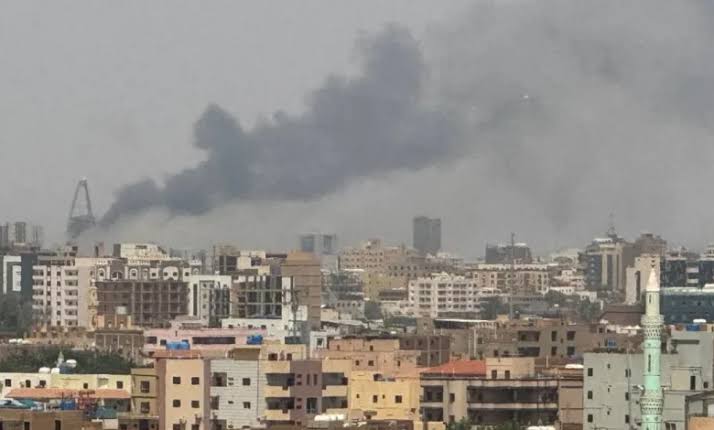
A Sudanese military airstrike on a market in North Darfur killed over 100 people on Monday, according to a pro-democracy lawyers’ group, marking yet another atrocity in the ongoing conflict between Sudan’s army and the paramilitary Rapid Support Forces (RSF).
The Emergency Lawyers reported that the strike, which also injured hundreds, targeted the town of Kabkabiya, approximately 180 kilometers (112 miles) west of El-Fasher, the state capital besieged by the RSF since May. The attack coincided with the town’s weekly market day, when residents from nearby villages had gathered, resulting in significant casualties, including women and children.
Footage purportedly showing the aftermath of the strike, provided by the Darfur General Coordination of Camps for the Displaced and Refugees, revealed people searching through rubble and charred remains. However, AFP has not independently verified the footage’s authenticity.
In a separate incident later that evening, three neighborhoods in Nyala, the capital of South Darfur, were reportedly struck by barrel bombs, although no casualties were confirmed.
Darfur, a region roughly the size of France, is home to about a quarter of Sudan’s population. Over half of its 10 million residents are displaced due to the 20-month conflict, which has left tens of thousands dead and millions on the brink of famine. A UN-backed report in July confirmed famine conditions in a major refugee camp in North Darfur following an RSF blockade that cut off trade and aid for months.
The Emergency Lawyers condemned the airstrike in Kabkabiya as a “horrendous massacre” and noted an additional incident in North Kordofan state, where a crashed drone exploded on Monday, killing six people. They accused both the army and the RSF of indiscriminately targeting civilians and deliberately bombing densely populated areas, contradicting claims by both sides that they only strike military targets.
The UN’s humanitarian chief, Tom Fletcher, recently called for urgent international action, citing the growing humanitarian crisis. During a visit to refugee camps, Fletcher described hearing “heart-rending stories” from those fleeing the violence. Nearly 26 million people—around half of Sudan’s population—are now at risk of starvation, with both warring factions accused of weaponizing hunger. “These numbers are staggering, and we cannot turn our backs,” Fletcher urged.