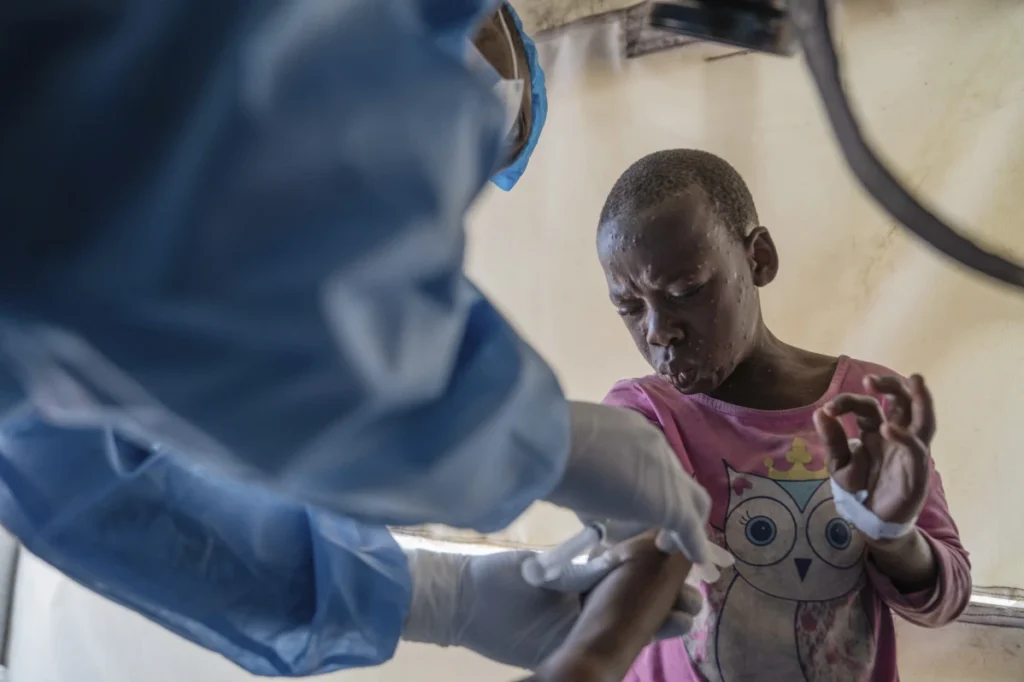
Health officials in Congo are reporting a stabilization of mpox cases, suggesting that the ongoing epidemic, which led the World Health Organization (WHO) to declare a global emergency in August, may be subsiding. Recent statistics indicate that Congo is now experiencing around 200 to 300 confirmed mpox cases per week, a decrease from nearly 400 cases in July. This trend is also noticeable in Kamituga, the mining city where the more transmissible variant of mpox first emerged.
However, the WHO has highlighted that only 40% to 50% of suspected infections in Congo are being tested, and the virus continues to spread in various areas, including Uganda. Despite the positive decline in cases, health experts are concerned about the low vaccination rates in Congo, which has only received 265,000 vaccine doses. Estimates suggest that only 50,000 individuals have been vaccinated in a country with a population of 110 million.
Dr. Zakary Rhissa, who leads operations for the charity Alima in Congo, stressed the urgent need for a more extensive vaccination campaign across the continent to control mpox’s spread and avert potential genetic mutations. He cautioned, “If we miss this opportunity, the likelihood of another significant outbreak increases substantially.”
This year, Africa has reported approximately 43,000 suspected mpox cases, resulting in over 1,000 deaths, mostly in Congo. Past outbreaks, such as the one in Nigeria in 2017, have shown that without effective containment, smaller outbreaks can escalate into larger global crises.
The recent decrease in cases in Kamituga, where the outbreak originated among sex workers and miners, provides a crucial opportunity to improve vaccination efforts, surveillance, and public education. Georgette Hamuli, an 18-year-old sex worker in Goma, noted her increased awareness of mpox after immunization teams visited her neighborhood. She recognized the risk and the importance of vaccination, saying, “The vaccine is also necessary. I think we’re now protected.”
The Africa Centers for Disease Control and Prevention estimates that Congo needs at least 3 million doses of the mpox vaccine to stop the virus’s spread, with an additional 7 million needed for the rest of Africa. Thus far, the WHO and partners have allocated 900,000 vaccines to nine affected countries in Africa, with an expectation of 6 million available by the year’s end.
Mpox outbreaks have also been reported in Burundi, Kenya, Rwanda, and Uganda, with cases identified in travelers in countries including Sweden, Thailand, Germany, India, and Britain. Alarmingly, fewer than half of the individuals most at risk in Congo have been vaccinated.
Experts are advocating for a transition from a charitable approach to a comprehensive public health strategy to facilitate widespread immunization. Bavarian Nordic, the manufacturer of the most widely used mpox vaccine, has promised to sell doses for Africa at the lowest possible price. However, an analysis by Public Citizen revealed that UNICEF paid $65 per dose for the Jynneos vaccine, considerably higher than that of most other vaccines.
Dr. Salim Abdool Karim, an infectious diseases expert at South Africa’s University of KwaZulu-Natal, indicated that while mpox outbreaks typically peak and decline rapidly, the current situation is complicated by transmission through sexual contact and ongoing spillover from infected animals. He emphasized that resolving the crisis relies on achieving widespread vaccination among the population.
