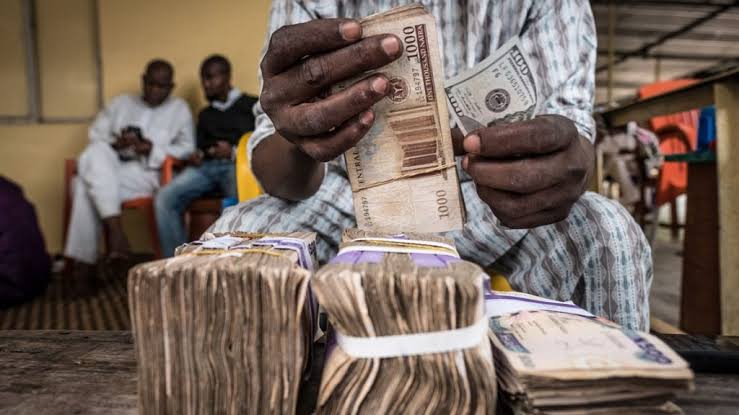
The naira closed the past week marginally weaker at the Nigerian Foreign Exchange Market (NFEM), depreciating by 0.14 per cent week-on-week to settle at ₦1,532.34/$, compared to the previous week’s close.
This decline came despite the currency rebounding to a four-month high of ₦1,518.88/$ on the first trading day of the week. Subsequently, the naira lost ground, dipping to ₦1,530.25/$ and later to ₦1,533.11/$, before recovering slightly to close the week at ₦1,532.34/$ at the official market.
Trading within the NFEM saw the naira fluctuate between a high of ₦1,538/$ and a low of ₦1,515/$ during the week.
At the parallel market, the local currency performed better, appreciating by 0.06 per cent week-on-week to close at ₦1,544.00/$1. It traded within a tighter band of ₦1,535.00/$1 to ₦1,544.00/$1, reflecting more stable sentiment compared to the official window.
Market analysts continue to underscore the importance of the Central Bank of Nigeria’s (CBN) interventions and improved foreign exchange liquidity in stabilising the naira. In its weekly commentary, Cowry Assets Management Limited highlighted the naira’s mixed performance across markets, attributing the divergence to supply-demand imbalances and evolving FX liquidity conditions.
“The naira looks to record further gains as improved oil output and elevated prices drive higher dollar inflows,” Cowry Assets stated, noting that such factors could sustain the pace of reserve accretion and bolster FX market stability.
Recent data from the Nigerian Upstream Petroleum Regulatory Commission supports this outlook. Nigeria’s crude oil production (excluding condensates) rose by 3.6 per cent in June to 1.51 million barrels per day, up from 1.45 mbpd in May. This marks the first time in five months that the country has met its OPEC quota, signalling improvements in operational efficiency and enhanced security at key oil sites.
AIICO Capital Limited, in its own market review, observed that intermittent CBN interventions—especially dollar sales early and late in the week—contributed to maintaining relative stability in the FX market. The report noted a $422 million rise in external reserves to $37.85 billion as of Thursday, up from $37.43 billion a week earlier.
Looking ahead, analysts expect the naira to hold within its current range, supported by improved liquidity. However, attention is turning to the Monetary Policy Committee (MPC) meeting that begins today. The outcome could influence future FX dynamics, with analysts split on the likely direction of interest rates.
Dovish voices are advocating for a modest rate cut, citing declining inflation, a steadier naira, and positive reform momentum. Meanwhile, hawkish analysts caution that easing too soon could reverse recent gains, especially amid persistent food supply shocks and global uncertainties.
“For now, traders are positioning around the edges, but the real signal will come from the tone of the communique,” noted Comercio Partners.
As Nigeria continues to navigate FX reforms and oil-driven revenue improvements, all eyes remain on the CBN’s policy response and how it will shape the naira’s trajectory in the near term.
