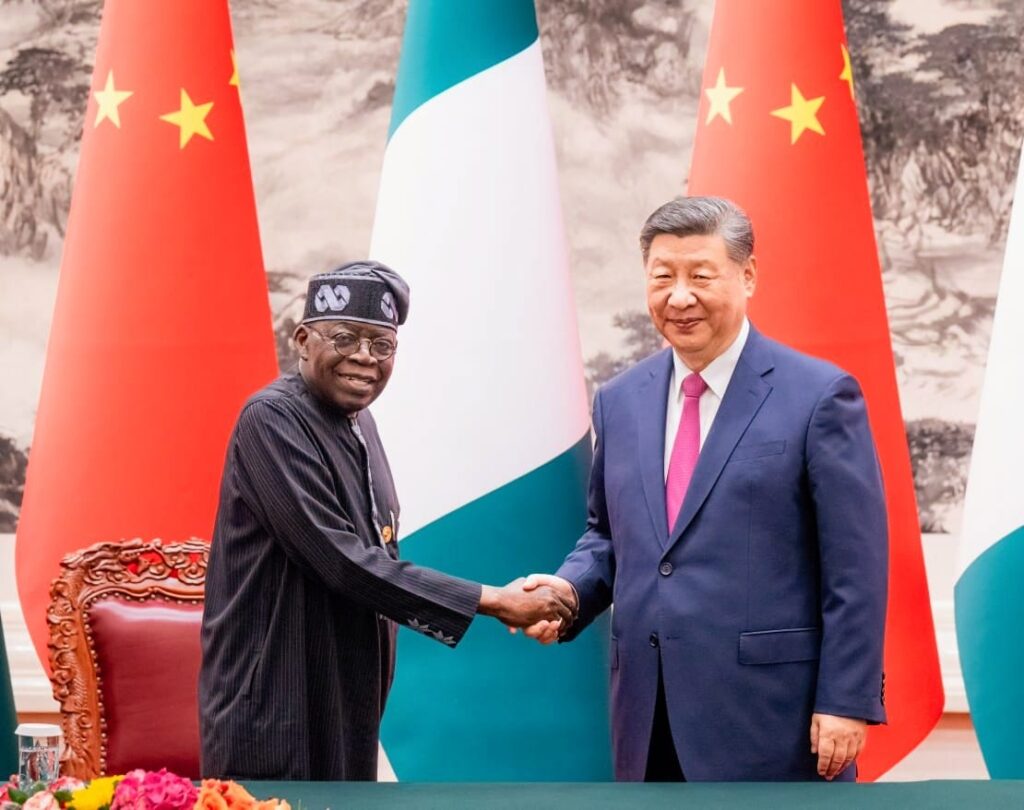
On Tuesday, President Bola Tinubu of Nigeria and Chinese President Xi Jinping announced the elevation of Nigeria-China relations to a comprehensive strategic partnership, marking a significant step in diplomatic ties. This development was a key outcome of President Tinubu’s official visit to China ahead of the 2024 Forum on China-Africa Cooperation (FOCAC) Summit.
During discussions in Beijing, both leaders agreed to build a high-level Nigeria-China community with a shared future. President Tinubu emphasized the importance of this partnership for Nigeria and Africa, citing Nigeria’s large population, young workforce, and economic potential as crucial factors for driving growth and development. He expressed appreciation for China’s commitment to enhancing trade, stability, and security in the West African sub-region.
Highlighting Nigeria’s ongoing economic reforms, Tinubu noted that these measures align with China’s successful economic strategies. “We are committed to sustainable growth through effective implementation of reforms,” he said, stressing Nigeria’s openness to foreign investment under favorable conditions.
President Xi Jinping reciprocated by acknowledging the longstanding mutual understanding between China and Nigeria, which has lasted over 50 years. He praised the new strategic partnership, describing it as a catalyst for further strengthening China-Africa relations and supporting the Global South’s collective progress.
The leaders witnessed the signing of several Memoranda of Understanding (MOUs) aimed at bolstering cooperation in various fields, including the Belt and Road Initiative, nuclear energy, human resource development, and media exchanges. One notable agreement was between China Media Group and the Nigerian Television Authority, signaling increased collaboration in media and communication.
In addition to these high-level talks, President Tinubu visited key Chinese companies, including the China Railway Construction Corporation (CRCC) and Huawei Technologies. The CRCC has played a significant role in Nigeria’s infrastructure development, with ongoing projects like the Ibadan-Abuja-Kaduna-Kano railway segments. President Tinubu reassured CRCC’s leadership of Nigeria’s commitment to completing these critical projects.
During his visit to Huawei’s Beijing Research Centre, Tinubu was briefed on the launch of the DigiTruck initiative, a mobile ICT classroom designed to improve digital literacy in underserved Nigerian communities. Huawei committed to supporting Nigeria’s digital transformation agenda, aligning with the government’s plans to train three million technical talents.
President Tinubu’s visit to China underscores Nigeria’s strategic importance in fostering strong international partnerships and advancing regional development initiatives. As the Chairman of ECOWAS, Tinubu’s role in these diplomatic engagements signifies a broader vision for enhancing economic cooperation and stability across West Africa.
