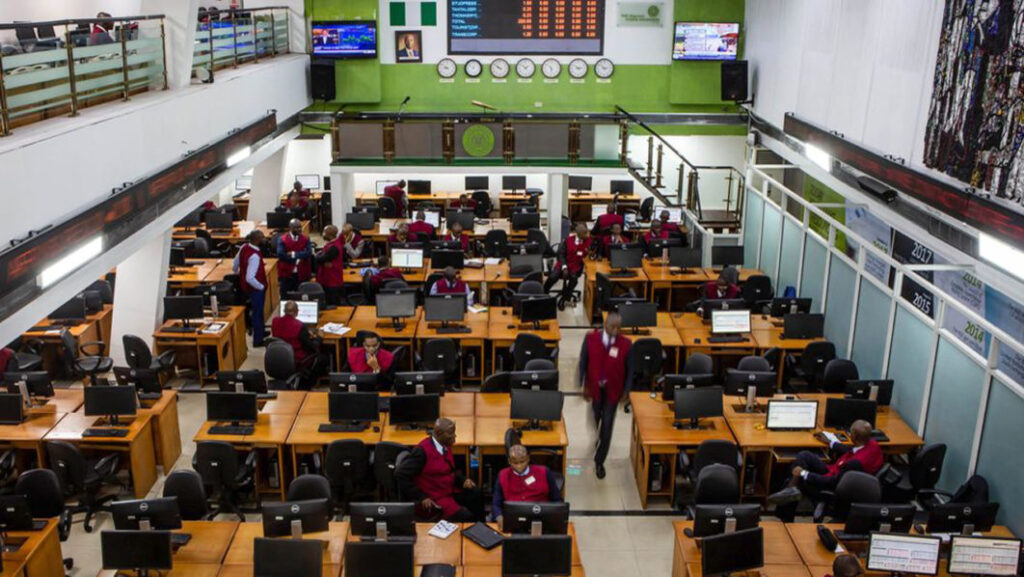
The Nigerian equity market made significant gains last week, adding N455 billion to its value despite the public holiday for Eid el-Maulud on Monday. The NGX All-Share Index increased by 0.81%, closing the week at 98,247.99 points, while the market capitalization rose to N56.457 trillion.
Investors traded 1.86 billion shares worth N38.45 billion across 40,228 deals during the week. This marked a decrease from the previous week’s 2.584 billion shares valued at N51.205 billion traded in 50,615 deals. Despite the drop in volume and value, the market continued to show strength in key sectors.
The financial services industry dominated trading activities, leading with 820.815 million shares worth N16.15 billion, accounting for 44.13% of total equity turnover volume and 42.01% of total equity turnover value. Following closely was the oil and gas industry, with 443.711 million shares worth N5.055 billion traded in 5,319 deals. The conglomerates sector ranked third, recording a turnover of 183.729 million shares valued at N2.971 billion in 2,510 deals.
Among individual stocks, Japaul Gold & Ventures Plc, First Bank of Nigeria Holdings Plc, and UAC of Nigeria Plc were the most traded equities by volume. Together, these three companies accounted for 728.034 million shares worth N10.03 billion in 4,374 deals, contributing 39.14% of total equity turnover volume and 26.09% of the total equity turnover value.
In other market activities, a total of 146,162 units of securities valued at N14.736 million were traded last week in 151 deals, a rise from the previous week’s 43,535 units valued at N13.476 million exchanged in 122 deals.
The market saw mixed performance among equities, with 41 stocks appreciating during the week, down from 52 in the previous week, while 40 equities depreciated, compared to 31 in the prior week. Meanwhile, 70 equities remained unchanged, slightly up from 68 in the previous week.
The domestic market performance was influenced by key monetary policy decisions from global central banks, including the US Federal Reserve, Bank of England, and the People’s Bank of China. Investors kept a close watch on these developments, which contributed to fluctuations in the market.
The Nigerian equity market’s continued resilience, despite global and domestic uncertainties, highlights investor confidence in the long-term growth potential of the country’s financial markets.
