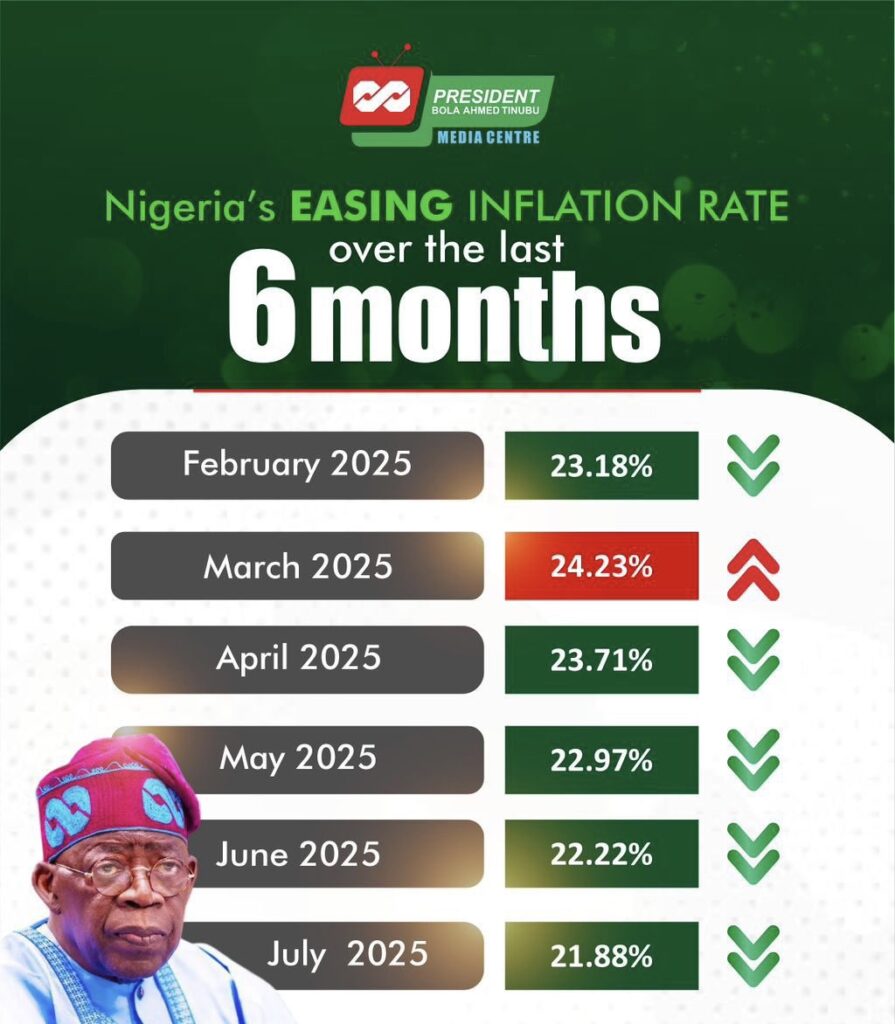
Nigeria has recorded a consistent decline in its inflation rate over the past five months, according to figures released by the Presidential Media Centre.
The data shows that in February 2025, inflation stood at 23.18%, before climbing to 24.23% in March—the highest rate recorded in the six-month period. However, from April onward, inflation began to ease steadily, dropping to 23.71% in April, 22.97% in May, 22.22% in June, and 21.88% in July.
Officials attribute the downward trend to government measures aimed at stabilizing the economy, controlling food prices, and improving supply chains. While the brief spike in March raised concerns, the sustained decline since April has been welcomed by economists and market analysts as a sign of potential economic recovery.
President Bola Ahmed Tinubu’s administration has pledged to continue implementing fiscal and monetary policies to further curb inflation, with the aim of achieving single-digit rates in the coming years.
Despite the progress, experts caution that the current rate still poses challenges for households and businesses, especially in the face of fluctuating global commodity prices and exchange rate pressures
