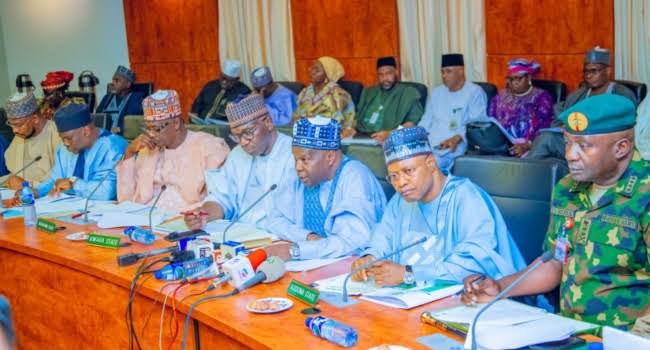
The Northern Governors’ Forum, representing 19 Northern states, has voiced strong opposition to a new derivation-based Value-Added Tax (VAT) distribution model proposed in ongoing tax reform bills before the National Assembly. At their meeting on Monday, October 28, 2024, the governors, led by forum chairman Governor Muhammed Inuwa Yahaya of Gombe State, released a communiqué expressing concerns that the model could unfairly disadvantage the region.
The meeting, attended by prominent Northern traditional rulers, including the Sultan of Sokoto, His Eminence Muhammadu Sa’ad Abubakar III, also acknowledged recent achievements in national security efforts under President Bola Tinubu’s administration. However, the governors urged the federal government to address what they called “misunderstandings and misgivings” surrounding the VAT reform.
President Tinubu and the Federal Executive Council have recently supported a series of tax reform bills aimed at overhauling Nigeria’s tax system, improving efficiency, and eliminating redundancies. The National Assembly is currently reviewing these reforms, which include four key bills: the Nigeria Tax Bill, Nigeria Tax Administration Bill (NTAB), Nigeria Revenue Service (Establishment) Bill, and the Joint Revenue Board Establishment Bill.
These bills seek to modernize Nigeria’s tax landscape without increasing existing tax rates, streamlining multiple taxes and enhancing the ease of compliance for businesses and individuals. A key focus of the reforms is to create a harmonized approach across federal, state, and local tax authorities.
The derivation-based VAT model, however, has sparked controversy. Currently, VAT revenue is distributed based on where the tax is remitted rather than where goods and services are consumed. The proposed model would shift this focus to the point of consumption or supply. The Northern governors argue that this model could lead to an uneven distribution of VAT revenue, potentially disadvantaging states that produce essential, VAT-exempt goods, like food, which are often consumed outside the region.
“This new approach threatens the financial stability of many Northern states,” Governor Yahaya stated in the communiqué, emphasizing the need for an inclusive VAT system that fairly accounts for each region’s economic contributions.
While President Tinubu’s administration defends the reforms as a means of ensuring a fairer and more efficient tax system, the governors’ concerns highlight the complexities of balancing regional interests within a unified tax framework. As the bills continue through legislative deliberation, the Northern governors’ opposition underscores the need for a solution that promotes equitable growth across all regions of Nigeria.
