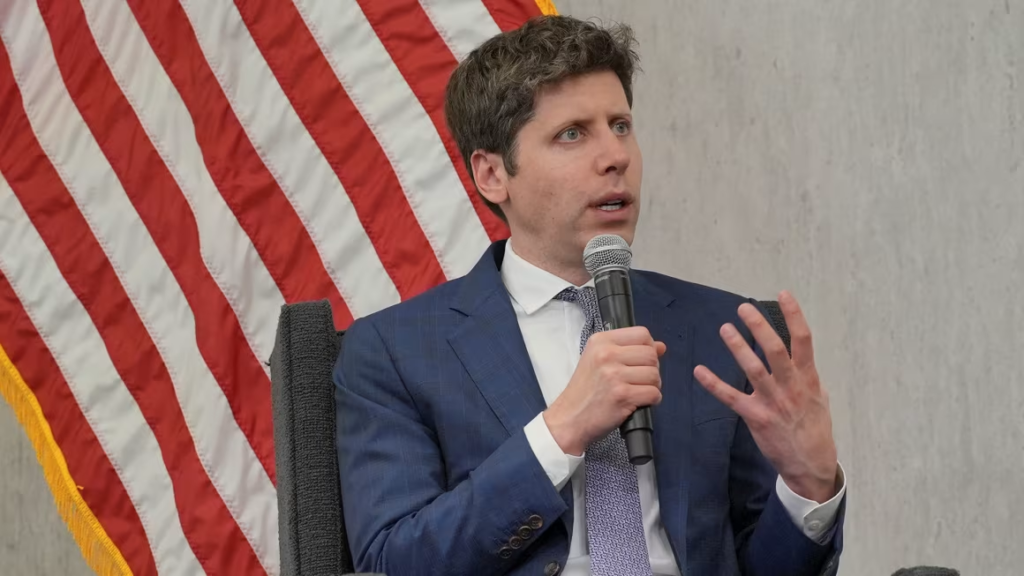
In a stark warning during his address at the Federal Reserve in Washington, D.C., OpenAI CEO Sam Altman cautioned that artificial intelligence (AI) could trigger a massive “fraud crisis” due to the increasing ability of AI systems to impersonate individuals with alarming precision.
Altman expressed concerns about the widespread use of voice authentication by financial institutions, a method he deems dangerously outdated. “A thing that terrifies me is apparently there are still some financial institutions that will accept a voice print as authentication for you to move a lot of money or do something else,” Altman said. “That is a crazy thing to still be doing… AI has fully defeated most of the ways that people authenticate currently, other than passwords.”
The warning from Altman came as part of a broader discussion on AI’s growing economic and societal impact. The event was attended by high-level representatives from major U.S. financial institutions, with the backdrop of imminent regulatory plans from the White House. The administration is expected to release its “AI Action Plan” soon, which will outline strategies for regulating AI and ensuring the U.S. retains its competitive edge in the global AI race.
OpenAI’s increasing influence on U.S. policy-making was further underscored by its announcement to open its first office in Washington, D.C., next year. The new office will house a team of 30 and will serve as a hub for AI research, training sessions for government officials, and hosting policymakers to preview new technologies.
The Growing Threat of AI Impersonation
Altman’s comments reflect a growing concern shared by others in the tech community, including law enforcement. The FBI issued warnings last year about AI-driven scams involving voice and video cloning. In one disturbing case, AI was used to impersonate the voices of parents’ children in a bid to extract money from them. More recently, U.S. officials discovered that an AI impersonator, posing as Secretary of State Marco Rubio, had contacted foreign ministers and U.S. lawmakers.
“I am very nervous that we have an impending, significant, impending fraud crisis,” Altman said, underscoring the urgency of addressing this emerging threat. “Right now, it’s a voice call; soon it’s going to be a video or FaceTime that’s indistinguishable from reality.”
Altman acknowledged that although OpenAI is not involved in creating such impersonation tools, the challenge of identifying and regulating AI-generated fraud will soon become a pressing issue. He also backed “The Orb,” a technology from Tools for Humanity designed to verify human identity in a world where AI increasingly blurs the lines between real and fabricated interactions.
AI Superintelligence: A Growing Concern
Alongside his concerns about AI’s potential to fuel fraud, Altman raised alarm over the risks of AI “superintelligence” falling into the wrong hands. “What keeps me up at night is the idea of bad actors using AI to create superintelligence,” Altman said. He specifically mentioned the threat of adversaries deploying AI to attack critical infrastructures like the American power grid or to create bioweapons. These concerns are amplified by growing fears in the White House and on Capitol Hill about China’s potential to surpass U.S. tech companies in AI development.
Altman further elaborated on the existential risks of AI, expressing worries about humans losing control over superintelligent systems or granting them too much autonomy in decision-making. “No one knows what happens next,” he said, acknowledging the unpredictable nature of AI’s future evolution.
AI and the Future of Work: ‘No One Knows’
Despite his concerns about AI’s potential for fraud and superintelligence, Altman is not as worried about its impact on jobs as some of his peers in Silicon Valley. Contrary to fears voiced by leaders such as Anthropic CEO Dario Amodei and Amazon CEO Andy Jassy, Altman does not believe that AI will necessarily lead to widespread job losses. Instead, he believes that predicting AI’s impact on the workforce is a complex and uncertain challenge.
“There’s a lot of these really smart-sounding predictions,” Altman said, “but no one knows that. In my opinion, this is too complex of a system, this is too new and impactful of a technology, it’s very hard to predict.”
He did, however, offer a vision for the future: “You have everything you could possibly need. You have nothing to do,” he said, imagining a future where work, as we know it, becomes irrelevant. “So, you’re making up a job to play a silly status game and to fill your time and to feel useful to other people.”
ChatGPT’s Role in Workforce Transformation
As part of OpenAI’s outreach to policymakers, the company released a report detailing ChatGPT’s positive impact on workforce productivity. Compiled by OpenAI’s Chief Economist Ronnie Chatterji, the report highlights how ChatGPT is already being used by 20% of U.S. users as a personalized tutor, aiding in learning and upskilling.
Chatterji, who previously served as a senior economist in the Biden administration, compared AI’s potential to transformative technologies like electricity and the transistor. He noted that ChatGPT now boasts over 500 million users globally. Moreover, he pointed out that more than half of its American users are between the ages of 18 and 34, suggesting significant long-term economic benefits as they continue to integrate AI tools into their professional lives.
Looking ahead, OpenAI plans to expand its study of AI’s economic impact, with a particular focus on how it might affect jobs in the U.S. workforce. This research will continue at the company’s new Washington, D.C., office.
