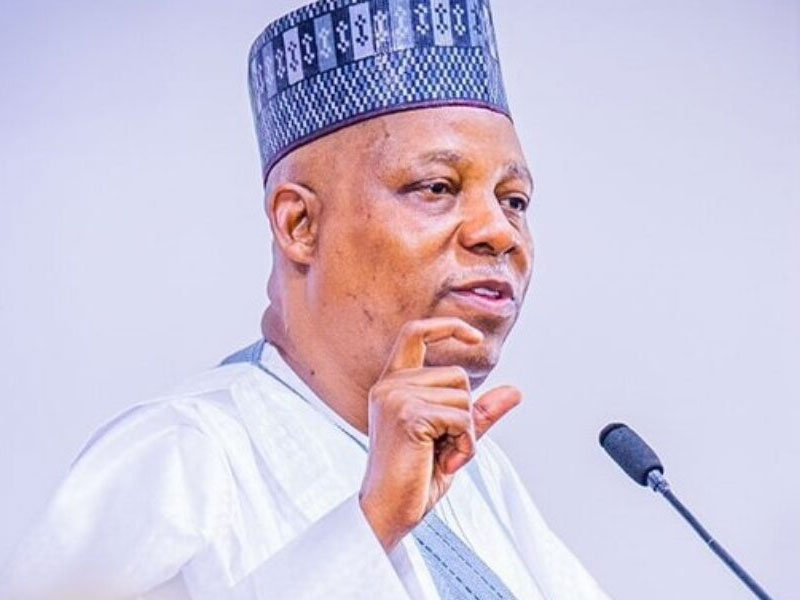
Vice President Kashim Shettima has reaffirmed the federal government’s support for Nigeria’s Oscar campaign, announcing that filmmakers will have access to the $618 million Investment in Digital and Creative Enterprises Programme (iDICE) as the country aims for its first Academy Award with the film Mai Martaba.
During a meeting with the film’s production team, led by the Minister of Arts, Culture, Tourism, and Creative Economy, Barrister Hannatu Musawa, at the Presidential Villa in Abuja on Thursday, the Vice President expressed his enthusiasm for Nigeria’s Oscar ambitions. According to a statement by his spokesman, Stanley Nkwocha, Shettima declared, “It’s a good day to be a Nigerian,” as he emphasized the power of the nation’s unity in the creative sector.
“We will ensure that every part of our nation is represented in this effort. Let’s unite and support this project because there is more that binds us than divides us. We are one people, and the film industry is a powerful way to reflect that unity,” Shettima said.
The Vice President also called on Minister Musawa to lead the charge in mobilizing resources for Nigeria’s Oscar bid, adding, “By the end of the century, Nigeria will be the most populous nation on earth, and there is great strength in numbers. I remain fully committed to ensuring that we win the Oscars.”
Directed by Prince Daniel, Mai Martaba has been officially selected as Nigeria’s entry for the 2025 Academy Award for Best International Feature Film. The film, which delves into themes of power, love, and female leadership within an ancient African kingdom, is seen as a strong contender for the prestigious award.
Minister Musawa highlighted that Nigeria is already making strides in building its creative industry. “We are working with global investors, and we’ve signed co-production agreements with South Korea, the UK, Japan, China, and France. We are also working towards establishing a media city, a one-stop hub for nine sectors within the creative industry,” she said. “The world is watching Nigeria not because of our oil, but because of our immense talent, content, and creativity.”
On the issue of funding, Musawa acknowledged the challenges but remained optimistic: “Many in the industry lack the infrastructure needed to produce world-class films. However, every Nigerian, regardless of their background, has the ability to create content with just a phone, empowering themselves for a brighter future.”
Prince Daniel, who is also the director of Mai Martaba, praised the creative sector’s rapid growth, pointing out that broadcasting now contributes more to Nigeria’s GDP than oil, reaching 12.3%. “The creative industry and broadcasting outperformed oil and mining in April 2020. We’ve created over 500 jobs and continue to expand. We are excited about taking the next step and pushing for an Oscar,” Daniel said.
He also noted that securing federal government backing is crucial for any country aspiring for an Oscar. “The support from the government is vital because the campaign is capital-intensive and requires high-level lobbying and diplomacy. South Africa’s Oscar win with Tsotsi in 2006 opened up their entire industry, and now no other African country has been able to catch up,” he added.
Stephanie Linus, chairperson of the Nigerian Official Selection Committee (NOSC) for the Oscars, emphasized that Nigeria’s Oscar campaign is not just about recognition but also about positioning the country on the global stage. “This is about building our presence in the global cinema industry, and the Oscars provide the biggest platform for that. We must start now,” she said.
