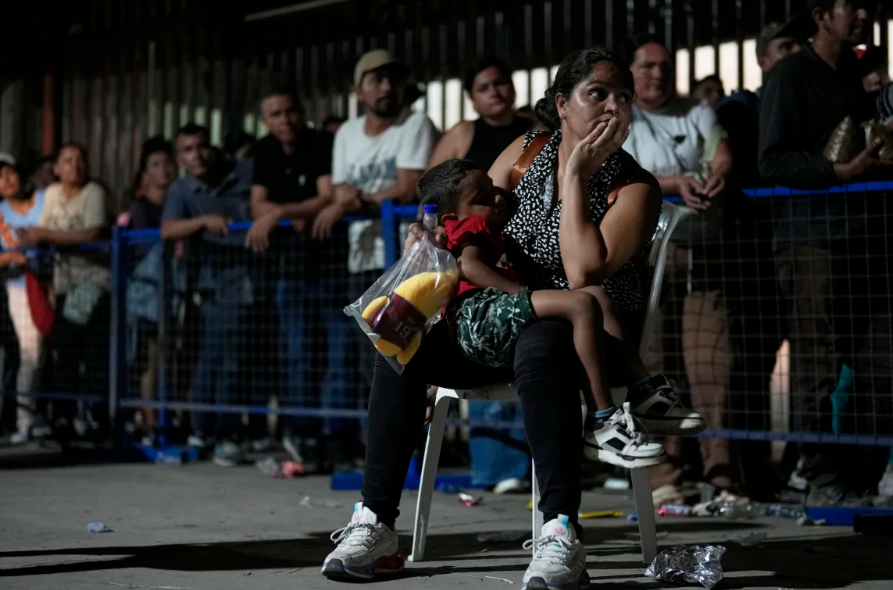
More than 32,000 people have fled towns in northeast Colombia to escape intensifying clashes between militant factions, according to the country’s ombudsman.
The violence has escalated dramatically in the Catatumbo region, displacing tens of thousands of residents. “Hundreds more remain confined to their homes and are unable to evacuate due to the ferocity of the clashes,” warned Iris Marín in a video statement on Tuesday. Colombian authorities report that 80 people have been killed in the fighting.
Displacement Crisis in Cúcuta
Nearly half of the displaced individuals have sought refuge in Cúcuta, a city near the Venezuelan border. Local officials have launched extensive relief efforts to accommodate over 15,000 arrivals in recent days.
Cúcuta’s football stadium has been repurposed into a welcome center, with thousands of displaced individuals receiving food, water, and clothing from local residents. Some victims are staying in hotels or with relatives.
“We are going to address the emergency that is occurring. Total solidarity, respect, affection, and love for these human beings who are arriving in the city of Cúcuta,” said Cúcuta Mayor Jorge Acevedo.
Strategic Violence in Drug Territory
The crisis stems from fierce clashes between the National Liberation Army (ELN) and splinter factions of the disbanded Revolutionary Armed Forces of Colombia (FARC). While both groups originated as left-wing guerrillas, they are now primarily involved in drug trafficking and other criminal activities, according to Elizabeth Dickinson, senior analyst at the International Crisis Group.
Catatumbo, a northeastern region bordering Venezuela, is a strategic area for drug production and trafficking. It has a long history of violence and remains one of Colombia’s most volatile regions.
In response, Colombian President Gustavo Petro suspended peace talks with the ELN, labeling their actions criminal. On Monday, he announced plans to declare a state of internal unrest, though the decree has yet to be signed.
Controversial Peace Policy
The Attorney General’s Office reactivated arrest warrants for 31 ELN members previously involved in peace negotiations. These warrants, suspended since 2022, were reinstated due to “the evidence and seriousness of the criminal acts” in Catatumbo.
Critics argue that President Petro’s “total peace” initiative, aimed at reducing violence through negotiations, has failed to address security issues.
“The crisis in Catatumbo should be a wake-up call for the Petro administration. Its ‘total peace’, coupled with the lack of effective security and justice policies, have allowed armed groups to expand their presence and brutal control over remote communities across Colombia,” said Juanita Goebertus, Americas director at Human Rights Watch.
International Assistance and Evacuations
In addition to Cúcuta, cities such as Ocaña and Tibú have received over 16,800 displaced individuals combined. Some victims have crossed into Venezuela, a nation that has seen its own exodus due to economic and political instability.
Venezuelan Foreign Minister Yván Gil stated that humanitarian aid is being provided to Colombian families arriving in border municipalities.
Colombia’s defense ministry reports that over 400 evacuations have been conducted in the Catatumbo region, with more than 5,000 soldiers and special forces deployed to Cúcuta to address the crisis.