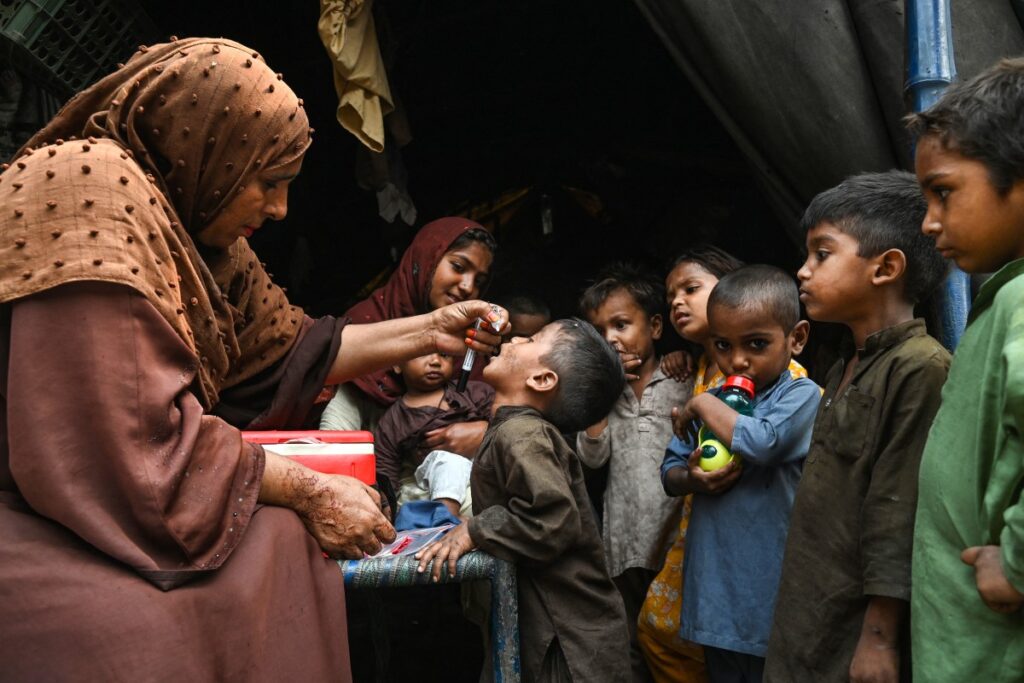
Militant attacks and the spread of misinformation are hindering Pakistan’s efforts to eradicate polio, yet dedicated volunteer health workers remain committed to the fight. Currently, Pakistan and Afghanistan are the only countries where this debilitating virus is endemic, primarily affecting children under five and sometimes leading to lifelong paralysis.
In Pakistan, polio cases have surged, with 45 reported this year compared to just six in 2023 and one in 2021. While the oral vaccine can easily prevent the disease, health workers in rural areas face significant risks to administer it.
Recently, seven individuals, including five children, were killed in a bombing targeting police assigned to protect vaccination teams. Just days prior, two police escorts were shot by militants.
“When we hear of attacks on vaccination teams, it saddens us deeply,” said health worker Zainab Sultan, 28, while going door-to-door in Panam Dehri in northwest Pakistan. “Our duty is to continue our work, protect children from disability, and ensure they grow up healthy.”
In the past, extremist clerics have spread false claims that the vaccine contained pork or alcohol, making it forbidden for Muslims. Additionally, a CIA-organized fake vaccination campaign in 2011 to track Osama bin Laden has fueled mistrust.
More recently, militant groups have increasingly targeted armed police escorts as part of their violent campaigns against the state. Since the Taliban’s return to power in Afghanistan in 2021, attacks in Pakistan have spiked, with officials asserting that hostile groups are now operating from across the border.
“Initially, nearly half of the parents in our area resisted the polio vaccine, thinking it was a Western scheme,” said local resident Ehsanullah. “There was a lack of awareness. If this disease spreads due to our reluctance, we’re not only harming ourselves but our entire community.”
Some religious leaders, who once fueled skepticism about the vaccine, are now leading efforts to persuade parents. “All major religious scholars in Pakistan have debunked the myths surrounding the polio vaccine,” said Imam Tayyab Qureshi. “Those who attack vaccination teams are not connected to Islam or humanity.”
For some parents, endorsements from religious leaders have been crucial. “I initially refused to vaccinate my children,” admitted Zulfiqar, 40. “But when our Imam explained the vaccine’s importance and shared that he vaccinated his own children, I changed my mind.”
In impoverished areas, some parents leverage the government’s commitment to vaccination as a bargaining chip, seeking investment in local infrastructure like water and roads. “We face demand-based and community boycotts,” lamented Ayesha Raza, a spokeswoman for the polio eradication campaign. “While your demands may be justified, please don’t link them to your children’s health.”
For some health workers, the fight against polio is personal. Ismail Shah, a polio survivor with a paralyzed leg, is resolute in his mission. “I decided as a child to fight against the disease that disabled me,” said the 35-year-old.
Shah is one of 400,000 volunteers working to educate families about the safety of the oral vaccine, which is administered in two doses. Their aim is to protect 45 million children, although the challenge is significant. Upon arriving in his area of 40,000 residents, Shah faced over 1,000 refusals. “Now, there are only 94 reluctant parents left, and I’m determined to persuade them as well,” he stated.
