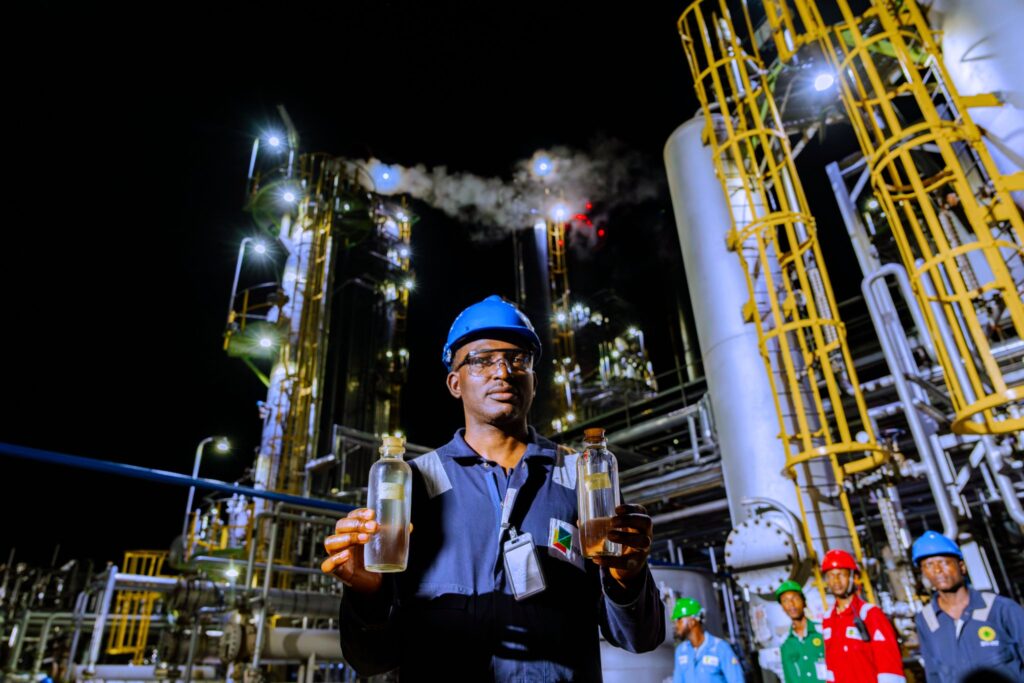
After multiple delays, the Port Harcourt Refinery Company has officially restarted fuel production, marking a major development for Nigeria’s energy sector. On Tuesday, the Nigerian National Petroleum Company Limited (NNPCL) announced the facility’s reopening, releasing around one million litres of refined products and committing to supply approximately 200 truckloads of fuel daily.
The refinery, now operating at 70% of its 60,000-barrel-per-day capacity, underwent significant upgrades to modernize its operations. According to NNPCL’s Group Chief Executive Officer, Mele Kyari, the facility’s capacity is expected to increase to 90% soon. Meanwhile, the larger refinery within the Eleme complex, which has a capacity of 150,000 barrels per day, remains under construction with no timeline provided, following President Bola Tinubu’s directive to avoid premature announcements.
At the facility’s unveiling, industry regulators and marketers observed the operations and inspected product samples. Farouk Ahmed, head of the Nigerian Midstream and Downstream Petroleum Regulatory Authority (NMDPRA), applauded the refinery’s revival, stating that it would boost local fuel supply, promote competition, and likely lead to lower prices.
Controversy arose later as reports suggested the refinery is blending rather than fully producing petrol, with critics claiming it lacks the necessary catalytic platform unit. NNPCL countered these claims, explaining that blending is a global standard for refineries and confirming the plant’s output, which includes petrol, diesel, and kerosene.
The development has been well-received by marketers. Joseph Obele, spokesperson for the Petroleum Products Retail Outlet Owners Association of Nigeria (PETROAN), described the reopening as a “dream come true,” while Chinedu Ukadike of the Independent Petroleum Marketers Association of Nigeria (IPMAN) praised the end of monopolies in the downstream sector, which now allows marketers to source fuel competitively.
President Tinubu congratulated NNPCL on the refinery’s success, acknowledging former President Muhammadu Buhari’s efforts in initiating the rehabilitation. He urged the company to fast-track the completion of the Warri and Kaduna refineries to further enhance domestic fuel production and energy security.
With the Port Harcourt refinery operational, alongside the Dangote refinery, Nigeria is taking steps toward reducing its dependence on fuel imports and establishing itself as a key player in the global energy market.