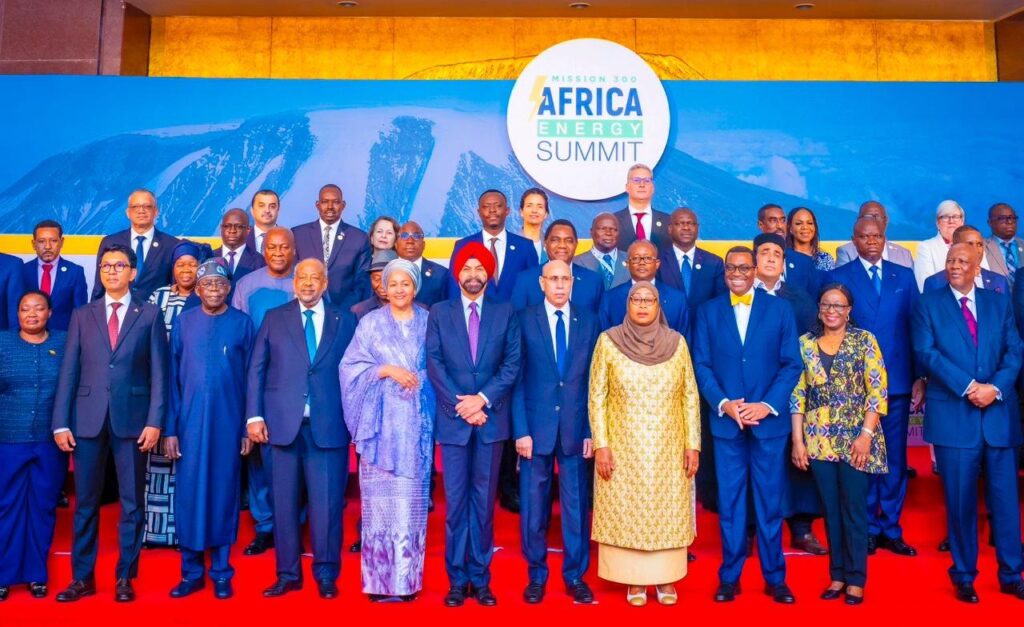
President Bola Tinubu has concluded a successful visit to Dar es Salaam, Tanzania, where he participated in the Mission 300 Africa Energy Summit. The two-day summit, held at the Julius Nyerere International Convention Centre, focused on the critical need for electricity access in Africa, with a goal to provide electricity to 300 million people by 2030.
Tinubu arrived in Tanzania on Sunday and is now returning to Abuja after engaging in high-level discussions with other African leaders, international organizations, and development partners. The Summit, hosted by the Tanzanian government in partnership with the African Union, the African Development Bank (AfDB), and the World Bank Group, culminated in the endorsement of the Dar es Salaam Declaration.
The Dar es Salaam Declaration calls for concerted efforts to expand electricity access across the continent by 2030. Twelve African nations, including Nigeria, Chad, Côte d’Ivoire, and Senegal, endorsed the Declaration, committing to providing electricity access to their citizens within the next five years through National Energy Compacts.
The Declaration outlines specific measures, including targeted reforms, to tackle energy sector challenges unique to each country. Nigerian President Tinubu, in a speech delivered by Minister of Power Adebayo Adelabu, praised the AfDB, the World Bank, and other partners for their support. “Let us work together to create a brighter future for our citizens—where every African can access reliable and affordable energy,” Tinubu said.
President Tinubu reaffirmed Nigeria’s commitment to ensuring reliable, affordable, and sustainable electricity for all citizens by 2030. Highlighting the substantial progress made, he pointed to the AfDB’s $1.1 billion investment aimed at providing electricity to five million Nigerians by 2026 and the $200 million Nigeria Electrification Project expected to benefit 500,000 people by 2025.
“Nigeria has set ambitious energy goals, but we can achieve them together. We are building a future powered by clean, renewable energy that will drive our economy forward,” Tinubu emphasized.
He also highlighted plans for the Nigeria Desert to Power initiative, which includes a $700 million AfDB investment to provide electricity to two million people, and a $500 million project to improve energy storage capabilities in the country. The President also cited the World Bank’s $750 million investment in Nigeria’s distributed energy access, which aims to bring power to 16.2 million people through mini-grids and solar systems.
The President used the occasion to outline Nigeria’s ongoing investments in renewable energy, particularly solar power, and the country’s push to develop electric vehicle (EV) infrastructure. Nigeria is in the final stages of establishing a nationwide EV charging network and is also implementing stricter vehicle emissions standards. The first 100 electric buses are already operational in the country.
“Nigeria’s energy sector is growing as a direct result of our reforms,” Tinubu said, noting that over $6 billion in new investments were secured in Nigeria’s energy sector in 2024 alone. The government continues to incentivize investments in renewable energy and energy efficiency in the oil and gas sector.
The Summit also saw announcements of significant international funding commitments. The International Finance Corporation (IFC) revealed it would allocate $70 million in private sector funding to five Nigerian Renewable Electricity Service Companies (RESCOs), through the Nigeria Distributed Access Through Renewable Energy Scale-Up (DARES) programme. The Rural Electrification Agency (REA) will oversee the implementation of the project.
The National Energy Compact presented by Nigeria at the Summit lays out specific timelines and targets for achieving last-mile electrification. This includes the need for $23.2 billion in investment, with contributions from both public and private sectors to expand power generation and enhance transmission infrastructure.
As President Tinubu and his counterparts return to their respective countries, the Mission 300 Summit has set the stage for a new era of energy collaboration in Africa. With commitments from key stakeholders, including international development organizations and African nations, the ambitious goal of providing electricity to 300 million people by 2030 appears more attainable than ever.
The President’s commitment to energy reform and sustainability is seen as a critical step toward transforming Nigeria’s energy sector and ensuring equitable access to power for all its citizens in the coming years.
