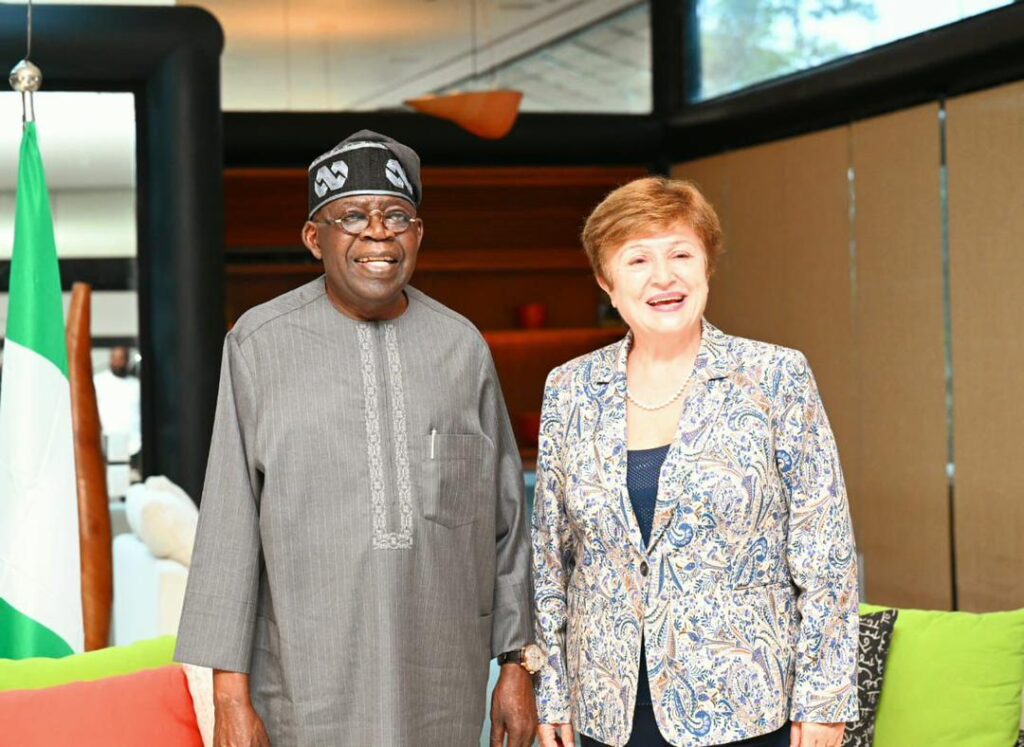
President Bola Ahmed Tinubu has reaffirmed his administration’s commitment to prioritizing the welfare of Nigeria’s poor and vulnerable populations, even as the government implements economic reforms designed to foster long-term growth.
The President made this pledge on Wednesday night during a courtesy visit by Kristalina Georgieva, Managing Director of the International Monetary Fund (IMF), on the sidelines of the G20 Leaders’ Summit in Rio de Janeiro.
Acknowledging the strain the reforms have placed on Nigerians’ purchasing power, President Tinubu emphasized the need for targeted social safety nets to mitigate the adverse effects. “We have started seeing positive results from our reforms, and the Nigerian people now understand the need for them, but we have to reduce the hardship that has resulted from the implementation,” he said.
Focus on Education and Infrastructure
President Tinubu highlighted the critical importance of education as a pathway out of poverty, stressing that the large number of out-of-school children remains a significant concern. “Education is a way out of hunger and poverty. That is why we are designing ways and incentives to keep these children in school, and we need your support for these kids who want to stay in school,” he told the IMF Chief.
The President also noted the need for substantial investment in infrastructure to stimulate economic development and enhance the country’s growth trajectory.
Tax Reforms for Inclusive Growth
Discussing his administration’s ongoing economic initiatives, Tinubu shared updates on tax reforms aimed at expanding the tax base while protecting citizens from additional financial burdens. “We are engaging stakeholders and sensitizing Nigerians to expand the economy’s tax base for inclusive developmental growth. We are doing this without necessarily increasing taxes on our people who have already given a lot,” he explained.
IMF’s Support and Perspective
Kristalina Georgieva praised the Tinubu administration’s economic reforms, highlighting the positive signals they have generated in global economic circles. She pledged the IMF’s continued support in diversifying Nigeria’s economy and enhancing its resilience to global economic shocks.
The IMF Chief lauded Nigeria’s social investment programs as effective mechanisms for cushioning the impact of reforms on vulnerable populations. She also assured President Tinubu of technical support in streamlining Nigeria’s budgeting process to achieve optimal results from loans and economic policies.
Global Economic Context
Georgieva emphasized that the IMF is committed to supporting vulnerable societies and emerging economies, countering the perception that the institution primarily serves developed nations. She noted that the IMF has injected $1 trillion into the global economy over the past two years to address the shocks caused by the pandemic, with a focus on helping developing nations build resilience.
She also informed President Tinubu of the IMF Executive Board’s recent approval of a third chair for Sub-Saharan Africa, enhancing the region’s representation within the organization. Additionally, she congratulated Nigeria for successfully hosting the IMF’s African Caucus meeting in Abuja in August 2024.
Deepening Regional Ties
Georgieva underscored the importance of regional economic integration and the IMF’s readiness to support Nigeria and its neighbors in fostering stronger ties. “It is the right of every country to benefit from the Fund after a critical analysis of its priorities,” she said, adding that the IMF is working with developing nations to prepare for future global economic challenges.
President Tinubu concluded the meeting by expressing appreciation for the IMF’s support and its commitment to aiding Nigeria’s economic recovery and growth. The engagement signals a strengthened partnership between Nigeria and the IMF as the country navigates its path toward stability and sustainable development.
