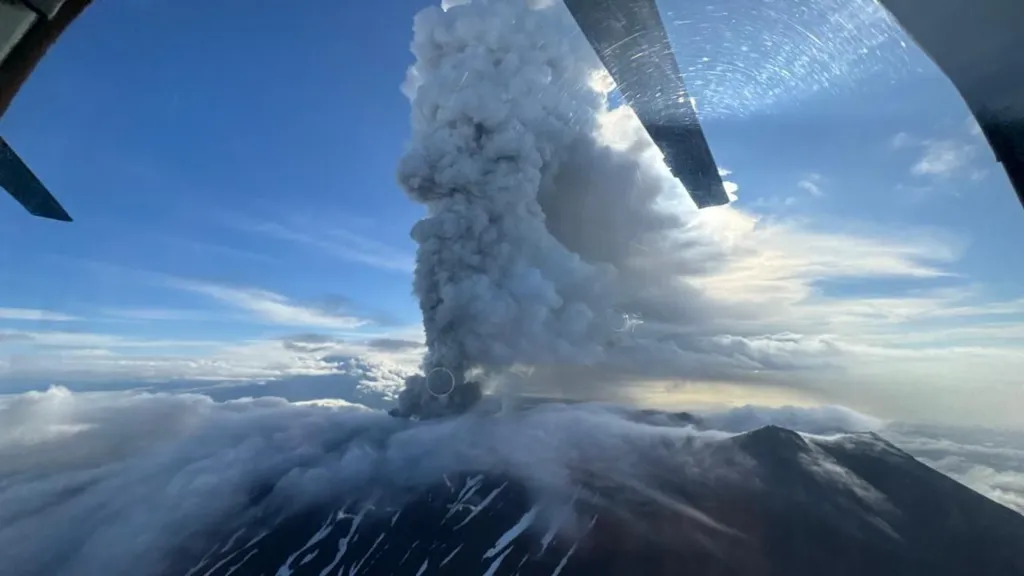
A long-dormant volcano in Russia has erupted for the first time in over five centuries, raising alarms among local experts. The Krasheninnikov Volcano, located on the Kamchatka Peninsula in far eastern Russia, sent an ash plume soaring as high as six kilometers (3.7 miles) overnight, marking a significant geological event. Experts believe that the eruption could be connected to a powerful earthquake that struck the region just a week prior.
The Russian Ministry of Emergency Situations has confirmed that there is no immediate threat to nearby populated areas, but the eruption has triggered widespread attention. The volcano’s last recorded eruption occurred in the 15th century, and experts believe the ongoing seismic activity might be linked to the aftershocks from a massive 8.8-magnitude earthquake that shook the region last week.
In addition to the eruption, the region experienced a series of significant tremors on Sunday, with a 7.0-magnitude quake shaking the Kuril Islands. Following this, tsunami warnings were issued in three areas of Kamchatka, though the waves were expected to be relatively small, with heights of up to 18cm (7in). Despite the low wave heights, the Russian Ministry urged residents in coastal areas to move away from the shore as a precautionary measure.
Seismic Activity May Be Linked to 8.8-Magnitude Earthquake
The powerful earthquake that struck the region last week—one of the strongest ever recorded—was a cause of considerable concern, leading to the evacuation of millions of people. Russian scientists had earlier warned that aftershocks from the earthquake could continue for weeks. The eruption of Krasheninnikov, coupled with Sunday’s earthquake, has led some experts to suggest that the two events may be interconnected, both stemming from the seismic instability of the region.
Olga Girina, head of the Kamchatka Volcanic Eruption Response Team, stated that while the eruption itself was significant, it was likely influenced by the recent tectonic disturbances. According to Girina, “The eruption may be linked to the earlier earthquake,” as both events are occurring in a region known for its volcanic and seismic activity.
The Kamchatka Peninsula, part of the Pacific “Ring of Fire,” is a hotspot for volcanic and earthquake activity due to its location along tectonic plate boundaries. Though the peninsula is remote, its geological activity is closely monitored by Russian scientists.
Global Seismic Activity and Tsunami Concerns
The recent earthquake in Russia was not an isolated event. The magnitude 8.8 quake triggered tsunami warnings as far away as French Polynesia and Chile, with concerns that the seismic waves could travel across the Pacific. While the tsunami threat has subsided, the global impact of such powerful earthquakes underscores the vulnerability of coastal regions to seismic events.
As for the volcano, Russian authorities remain on alert, keeping a close watch on any potential developments. Experts will continue to assess the situation in the coming days to determine whether the eruption could lead to further seismic activity or pose new risks.
For now, the Russian Ministry has assured the public that there is no immediate threat to life or property, but continued vigilance is required as seismic activity persists in the region.
