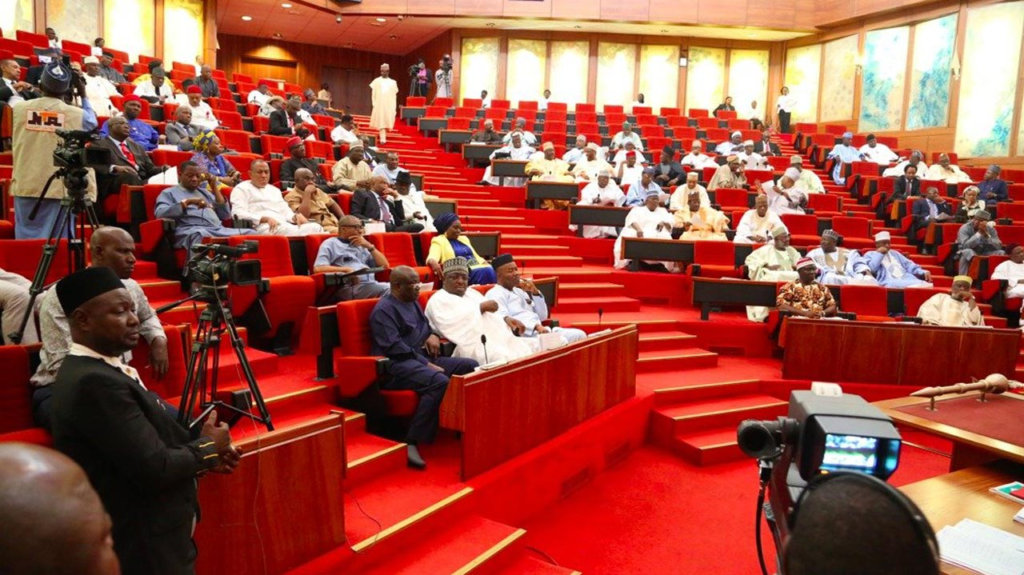
A motion sponsored by Senator Ali Ndume (APC, Borno South) and co-sponsored by Senators Sani Musa (APC, Niger East), Aliyu Wamakko (Sokoto North), and Ibrahim Bomai (Yobe South) on the alleged systemic genocide against Christians in Nigeria is set for debate by the Senate as plenary resumes Tuesday.
Lawmakers in both the Senate and House of Representatives are reconvening after their annual recess, which began on July 23, 2025.
The motion, titled “Urgent Need to Correct Misconceptions Regarding the Purported ‘Christian Genocide’ Narrative in Nigeria and International Communities,” urges the federal government—particularly the Ministry of Foreign Affairs and relevant security agencies—to adopt a data-driven approach in public communication.
The senators called for the release of verified casualty figures, contextual reports, and investigative findings to counter what they described as widespread misinformation about Nigeria’s security challenges, both locally and abroad.
Senator Ndume and his co-sponsors said the motion aims to address a “dangerous misrepresentation of the country’s security challenges as a campaign of Christian genocide.”
Ndume, in the draft motion, expressed concern over what he called the “increasing circulation of misleading narratives” in local and international media alleging a systematic genocide against Christians in Nigeria.
While acknowledging the tragic attacks suffered by Christian communities, he stressed that violence in Nigeria has affected citizens of all faiths, including Muslims and adherents of traditional religions.
The senator warned that framing the ongoing security crisis in purely religious terms “risks inflaming sectarian divisions, distorting international understanding, and undermining national unity.”
He emphasized that terrorism, insurgency, banditry, communal clashes, and other forms of criminal violence have taken lives among both Christian and Muslim communities.
The lawmakers also voiced concern over recent moves within the United States Congress and Senate to designate Nigeria as a Country of Particular Concern (CPC) over alleged religious persecution. They proposed engaging U.S. lawmakers, international partners, and Nigerian diaspora groups through official briefings and fact-based publications to correct prevailing misconceptions.
Allegations of genocide against Christians in Nigeria have persisted for years, often amplified by international advocacy groups, religious organizations, and Western media outlets. These claims highlight attacks by terrorist groups such as Boko Haram and violent conflicts involving pastoralists, which they say have disproportionately affected Christian communities in the Middle Belt and northern regions.
The renewed debate follows Vice President Kashim Shettima’s recent address at the United Nations, which reignited global attention on religious violence in Nigeria.
Adding to the controversy, American talk show host Bill Maher claimed during the September 26, 2025 edition of HBO’s “Real Time with Bill Maher” that 100,000 Christians had been killed in a “systematic genocide” in Nigeria.
Maher said: “I’m not a Christian, but they are systematically killing the Christians in Nigeria. They’ve killed over a hundred thousand since 2009. They’ve burned 18,000 churches. These are the Islamists, Boko Haram. This is so much more of a genocide attempt than what is going on in Gaza. They are literally attempting to wipe out the Christian population of an entire country.”
However, several Muslim organizations have rejected such claims, arguing that Muslims are equally victims of terror attacks. In 2022, the Muslim Rights Concern (MURIC) stated that 32,000 Muslims were killed within three years in Nigeria.
“Boko Haram in particular has killed, maimed, and displaced more Muslims than Christians; more Muslim clerics and more Muslim traditional rulers have been killed or kidnapped than Christians,” MURIC said, adding that “more Muslim-majority states are under siege by terrorists than Christian-majority ones.”
The federal government has also refuted allegations that terrorists in Nigeria are committing systematic genocide against Christians.
President Bola Tinubu, speaking in Owerri, Imo State, maintained that “no faith is under siege” in Nigeria.
“Here, no faith is under siege, no community is excluded. Our churches, mosques, and traditional shrines stand side by side—not as rivals, but as symbols of the unity that binds us,” Tinubu said during the unveiling of a book authored by Imo State Governor Hope Uzodimma.
The Minister of Information and National Orientation, Mohammed Idris, also rejected the narrative of targeted religious persecution, describing it as a “gross misrepresentation.”
“While Nigeria, like many countries, has faced security challenges, including acts of terrorism perpetrated by criminals, couching the situation as a deliberate, systematic attack on Christians is inaccurate and harmful,” he said.
The Senate debate on Ndume’s motion is expected to draw significant attention as Nigeria grapples with both domestic insecurity and the international perception of religious conflict within its borders.
