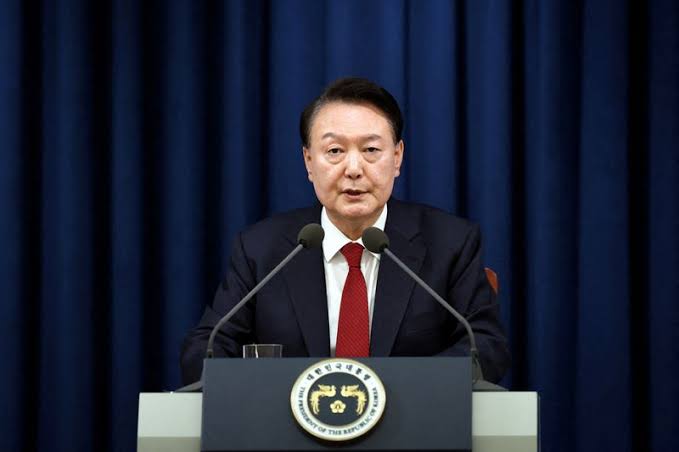
South Korean President Yoon Suk Yeol issued a public apology on Saturday following his controversial declaration of martial law earlier this week, a move that shocked the nation and drew widespread condemnation. However, Yoon stopped short of stepping down as protesters gathered outside parliament ahead of a critical impeachment vote that could determine his political future.
On Tuesday night, Yoon declared martial law—the first such order in over 40 years—deploying troops and helicopters to the National Assembly. Lawmakers, however, managed to overturn the decree in an extraordinary session, forcing Yoon to rescind the order early Wednesday morning.
In his first public appearance since the crisis, Yoon addressed the nation in a televised speech, bowing deeply as a gesture of contrition. “The declaration of martial law arose from my desperation as president,” he said. “I caused anxiety and inconvenience to the public. I sincerely apologize.”
Despite the apology, Yoon did not offer to resign, instead stating that he would “entrust the party with measures to stabilize the political situation, including my term in office.” This stance has drawn criticism from both opposition and ruling party members, with many calling for his immediate departure to restore political stability.
Divided Parliament Prepares for Impeachment Vote
Parliament is set to vote on Yoon’s impeachment later Saturday, but it remains uncertain if the motion will pass. The opposition, which holds 192 of the 300 seats, needs just eight defections from Yoon’s People Power Party (PPP) to secure the two-thirds majority required. If passed, Yoon would be suspended pending a ruling by the Constitutional Court.
Opposition leader Lee Jae-myung criticized Yoon’s address as “very disappointing,” arguing that the only resolution to the crisis is either Yoon’s resignation or his removal through impeachment.
Meanwhile, the PPP is deeply divided. Party leader Han Dong-hoon publicly stated that Yoon’s continued presidency is untenable, warning of greater political chaos if he remains in office.
Protesters Demand Accountability
By Saturday afternoon, hundreds of protesters had gathered outside the National Assembly in Seoul, with organizers expecting up to 200,000 participants. Some demonstrators camped overnight in freezing temperatures, while opposition lawmakers stayed in parliament, fearing further action by Yoon to retain power.
“I just want him to step down,” said Han Jeong-hwa, a 70-year-old housewife watching Yoon’s speech at Seoul Station. Retiree Lee Wan-pyo called the president’s actions “unforgivable,” echoing the sentiments of many South Koreans who feel betrayed.
Martial Law Drama Shocks Nation and Allies
Yoon’s declaration of martial law on Tuesday was intended, he claimed, to “eliminate anti-state elements plundering people’s freedom and happiness.” Security forces sealed the National Assembly, helicopters landed on its roof, and nearly 300 soldiers attempted to lock down the building.
In chaotic scenes, parliamentary staffers blocked soldiers with sofas and fire extinguishers, while lawmakers scaled walls to enter and vote down the order. Reports suggest soldiers were instructed to detain key lawmakers, but some military leaders hesitated, realizing the political nature of the situation.
The crisis has evoked painful memories of South Korea’s autocratic past and blindsided international allies, including the United States, which reportedly learned of the declaration via television. US Secretary of State Antony Blinken expressed hope on Friday that “the democratic process will prevail.”
An opinion poll released Friday showed Yoon’s approval rating had plummeted to a record low of 13 percent, leaving his political future hanging in the balance as South Koreans await the outcome of Saturday’s impeachment vote.
