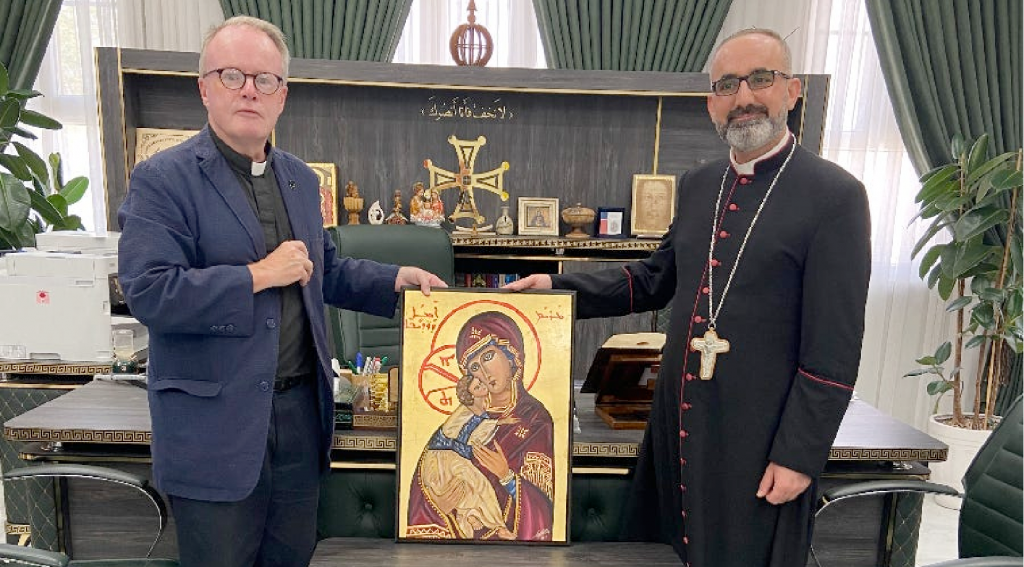
A new shrine dedicated to Mary, Mother of Persecuted Christians, is being established in the heart of Iraq’s Christian homeland, Qaraqosh. This shrine, located within the recently built Church of St. Ephrem, will be the seventh of its kind worldwide. Its central focus will be an icon, delivered in August by Father Benedict Kiely, founder of Nasarean.org, and painted by Syriac Catholic deacon Ibraheem Yaldo, who himself was displaced during the ISIS occupation of the region. The icon bears the Aramaic inscription “Mary, Mother of the Persecuted.”
Qaraqosh, once home to a thriving Christian community, was emptied in 2014 when ISIS overran the region, forcing Christians to flee their homes and churches. During the occupation, ISIS used Christian sanctuaries as military outposts, and it was only in 2016, with the help of the Popular Mobilization Forces, that the city was liberated. However, the hardships continued as the city lay in ruins, and many Christians faced difficult decisions about returning.
Archbishop Benedict Younan Hano, head of the Syriac Catholic Archeparchy of Mosul, emphasized the significance of the shrine’s timing, which coincides with the day Qaraqosh’s Christians fled eleven years ago. Hano hopes the shrine will inspire Western Christians to pray for their Middle Eastern brethren, reminding them of the deep roots of Christianity in the region.
The Syriac Catholic Church, one of the 23 Eastern Catholic Churches in full communion with Rome, continues to use Syriac, the dialect spoken by Christ and the apostles. Despite the decline in numbers—from 1.5 million Christians in Iraq in 2003 to perhaps 150,000 today—the faithful continue to hold on to their heritage.
Six other shrines to Mary, Mother of Persecuted Christians, exist in the United States, the United Kingdom, Sweden, and Kazakhstan. The Qaraqosh shrine will be the first in the Middle East, with plans for three more worldwide by 2026. Once completed, this sanctuary will serve as a poignant reminder that a community, once marked for extinction, continues to worship and pray in the language of their ancestors.
