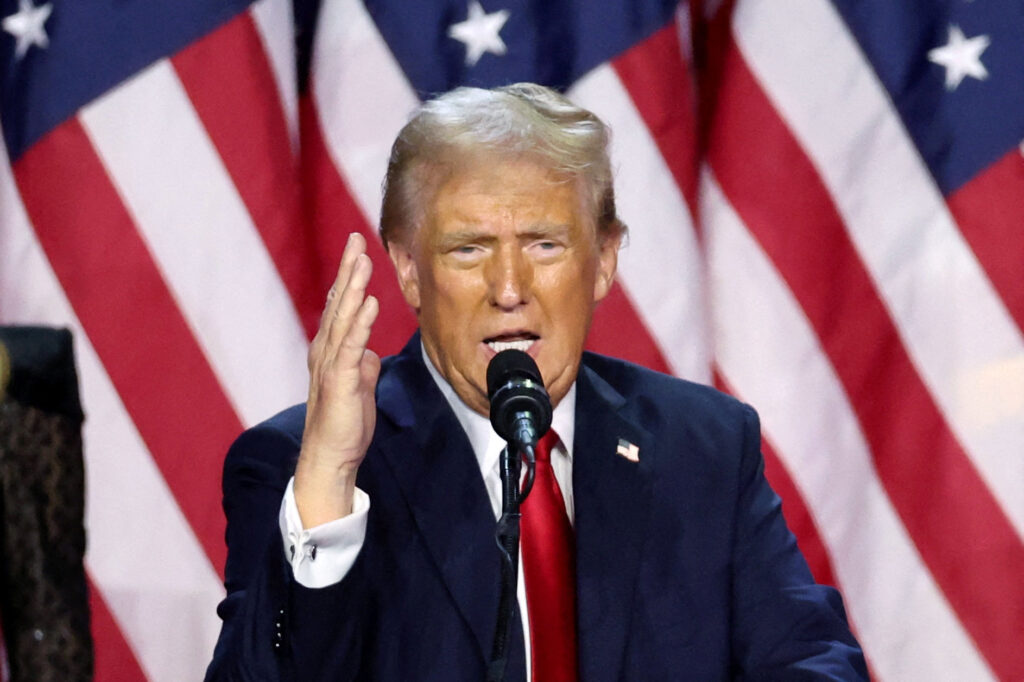
Donald Trump, following his victory in the 2024 presidential election, is expected to launch a sweeping effort to deport record numbers of immigrants, drawing on resources from across the U.S. government and leveraging cooperation from Republican-led states. Trump’s deportation strategy aims to fulfill a central promise of his campaign—one focused on a major crackdown on illegal immigration—and could involve using everything from military personnel to U.S. diplomats abroad to turn his plan into reality, according to six former Trump officials and allies.
In a victory speech, Trump described the election as a mandate for bold action, including his pledge to carry out mass deportations. His running mate, JD Vance, has estimated that Trump’s administration could remove up to 1 million people annually under this new strategy.
Immigrant advocacy groups, however, warn that such a large-scale deportation operation would be expensive, divisive, and inhumane, potentially leading to family separations and significant harm to communities. While deportations were a cornerstone of Trump’s first term, efforts fell short of his ambitious goals. In fact, under President Biden, more immigrants were deported in 2023 than in any year of Trump’s presidency, thanks to a combination of deportations and “returns” to Mexico by U.S. border officials.
A massive deportation push in a second term would require substantial additional resources, including more immigration officers, detention centers, and immigration judges. The American Immigration Council has estimated that deporting 13 million undocumented immigrants would cost around $968 billion over just over a decade.
Tom Homan, former acting director of U.S. Immigration and Customs Enforcement (ICE) and a likely appointee in Trump’s second administration, suggested that the scale of deportations would depend largely on the federal budget. “It all depends on what the budget is,” he said in an interview.
Despite the practical challenges, Trump’s allies believe the administration could overcome obstacles by mobilizing various federal agencies and even deploying National Guard troops from states that support the effort, a move that would likely lead to legal challenges. Trump’s deportation strategy could also face resistance from government employees who oppose such policies, including those in the asylum screening process.
The American Civil Liberties Union (ACLU) and other advocacy groups are bracing for another wave of legal battles should Trump push forward with aggressive deportation tactics. Lee Gelernt, an ACLU attorney who fought against Trump’s controversial family separation policy, said the organization has been preparing with a team of 15 lawyers in anticipation of a Trump return. “We definitely need to be coordinated and have more resources, because I think they will come in much more prepared,” he said.
A significant part of Trump’s deportation strategy would involve leveraging the U.S. State Department to push other nations to accept deported citizens, a challenge that stymied Trump’s first term. Trump’s former officials, including Ken Cuccinelli, former acting deputy secretary of the U.S. Department of Homeland Security, described the State Department as a “roadblock” to immigration enforcement, arguing that aggressive appointees would be key to overcoming this issue.
Christopher Landau, the former U.S. ambassador to Mexico, echoed this frustration, noting that U.S. diplomats were often reluctant to prioritize immigration enforcement. “Nobody really thought that was their problem,” Landau said at a recent panel discussion.
One critical obstacle for ICE—whose personnel is split between homeland security investigations and immigration enforcement—could be the need to repurpose agents focused on transnational crime to handle immigration cases. Some ICE officers have distanced themselves from deportation work in recent years, citing concerns that deportation fears undermine trust in immigrant communities, which is essential for effective law enforcement.
Trump’s allies have discussed using wartime legal powers, including the 1798 Alien Enemies Act, to expedite deportations, particularly of alleged gang members. This would almost certainly face legal challenges, as the law has a controversial history, being used during the War of 1812, World War I, and World War II to justify internment camps for citizens of enemy nations. Critics, including the Brennan Center for Justice and the ACLU, have called for the law’s repeal, warning that it could be used to justify indefinite detention and swift deportations without due process.
“I worry a little about overpromising,” said George Fishman, a former DHS official under Trump, cautioning that the administration would need to prove that the deported individuals were sent by foreign governments, an argument that could be difficult to substantiate.
As Trump’s administration gears up for a second term, the debate over his mass deportation plans is set to intensify, with significant legal, logistical, and ethical challenges ahead.
