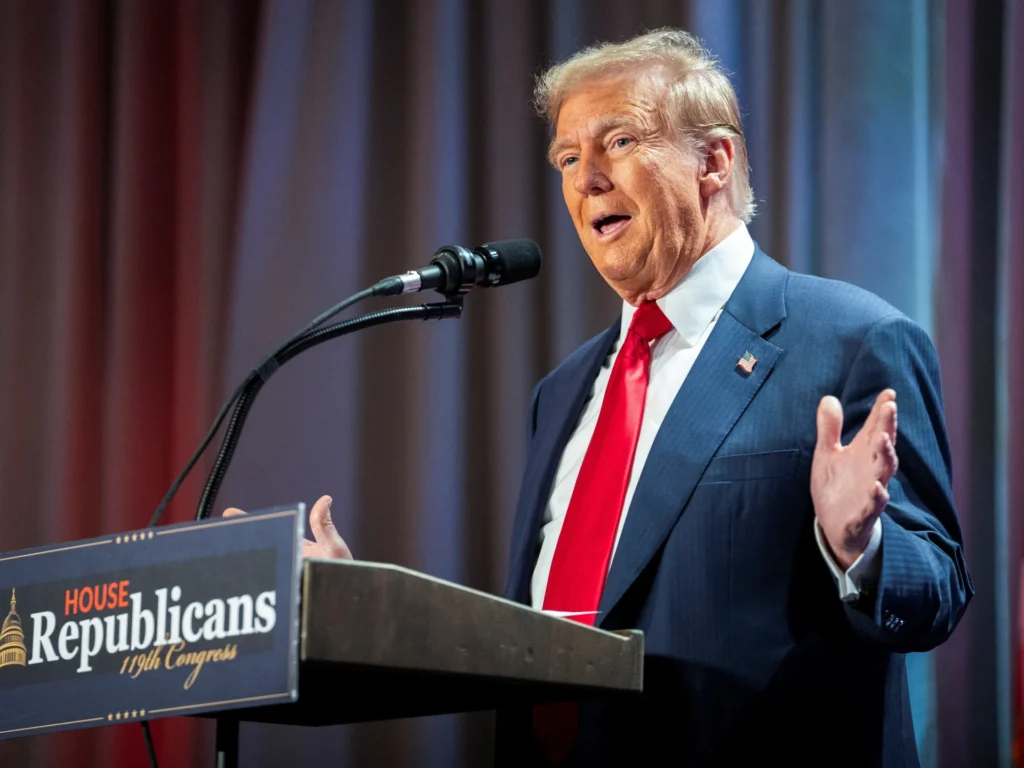
Donald Trump has announced plans to impose new tariffs on China, Mexico, and Canada starting on the first day of his presidency, aiming to force these countries to address illegal immigration and drug smuggling into the United States.
The president-elect stated that immediately after his inauguration on January 20, he would sign an executive order to impose a 25% tariff on all goods from Mexico and Canada. Additionally, a 10% tariff would be placed on Chinese goods unless the Chinese government takes stronger action to block the flow of fentanyl, a synthetic opioid, into the U.S.
If Trump follows through with these proposals, it would escalate tensions with America’s three largest trading partners. The tariffs could disrupt global supply chains and heavily impact the economies of the targeted countries.
Trump emphasized that the tariffs on Mexico and Canada would remain in effect until both countries take significant action to stop the illegal drug trade and reduce the number of migrants crossing the U.S. border. In a post on his Truth Social platform, he stated that both countries have the “absolute right and power” to address the issue.
Trump also criticized Beijing for not following through on promises made by Chinese officials to implement the death penalty for those caught dealing fentanyl. A Chinese embassy spokesperson responded by refuting Trump’s claims, stating that the idea of China knowingly allowing fentanyl precursors to enter the U.S. is false and counter to reality.
The Biden administration has been urging China to do more to curb the production of fentanyl, which has been linked to nearly 75,000 deaths in the U.S. in the past year.
During his campaign, Trump suggested tariffs on Mexico and China could reach up to 100% if necessary, much higher than those imposed during his first term. He also proposed ending China’s most-favored-nation status, which provides preferential trade terms.
In 2023, over 80% of Mexico’s exports and around 75% of Canada’s exports went to the U.S. Despite their ongoing trade tensions, the U.S. remains a major destination for Chinese exports, accounting for about 15% of the country’s total exports.
Trump views tariffs as a tool to boost the U.S. economy, protect jobs, and generate tax revenue, arguing that these taxes would not burden American consumers but would be a cost to other countries. Economists largely dispute this view, arguing that tariffs tend to raise prices for consumers and disrupt trade.
Stephen Roach, Senior Fellow at Yale Law School’s Paul Tsai China Center, noted that Trump’s proposed tariffs align with his campaign promise to use tariffs as a strategic tool to achieve his policy goals. Trump’s Treasury Secretary nominee, Scott Bessent, previously suggested that the president-elect’s tariff threats were part of a broader negotiation strategy, noting that “escalate to de-escalate” was often Trump’s approach.
At the same time, China’s economy is in a more vulnerable position than it was during Trump’s previous presidency, facing challenges such as a property market crisis, weak domestic demand, and rising local government debt.
These new tariffs would likely violate the terms of the US-Mexico-Canada Agreement (USMCA), the trade deal Trump signed into law in 2020, which maintained a largely duty-free trade relationship between the three countries.
Following Trump’s tariff announcement, he held discussions with Canadian Prime Minister Justin Trudeau on trade and border security, according to Reuters. Mexico’s finance ministry responded by emphasizing the importance of the USMCA in providing certainty for investors and affirming that Mexico is the U.S.’s top trade partner.
