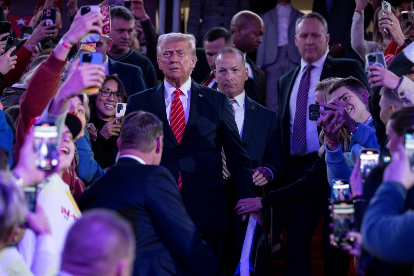
Donald Trump was sworn in Monday as the 47th president of the United States in a historic return to power, marking the most extraordinary political comeback in modern American history. The 78-year-old Republican, who previously served as the 45th president, pledged to usher in a “golden age” for America, though his return has sparked both jubilation and trepidation at home and abroad.
Due to record-breaking cold temperatures, Trump and Vice President J.D. Vance took their oaths of office inside the Capitol Rotunda — a rare move last seen during Ronald Reagan’s second inauguration in 1985. Despite the subdued setting, Trump’s tone was anything but tempered, promising swift and decisive action to reshape the nation’s trajectory.
“I will act with historic speed and strength to fix every single crisis facing our country,” Trump declared at an inauguration-eve rally. His speech struck a balance between optimism and the combative rhetoric that has become his hallmark. He vowed to reverse policies implemented by his predecessor, Joe Biden, through a blitz of executive orders addressing immigration, energy production, and education.
The inauguration ceremony featured prominent figures, including tech moguls Elon Musk, Mark Zuckerberg, and Jeff Bezos, with Musk set to play a leading role in the administration’s cost-cutting initiatives.
In his inaugural address, Trump described a “brand new day” for America, contrasting sharply with the “American carnage” theme of his 2017 inauguration. Yet, his speech also returned to familiar themes of border security and cultural conservatism.
“We will stop the invasion of our borders and end woke policies destroying our schools,” Trump said, doubling down on his pledge to combat “transgender insanity” in education and pardon January 6 rioters.
Despite the celebratory atmosphere among his supporters, many Americans remain wary of Trump’s vows of retribution against political opponents and journalists. His return to the White House, following an election victory over Democratic Vice President Kamala Harris, has intensified political polarization across the country.
Trump’s second term is a historic rarity, making him the first president since Grover Cleveland in 1893 to return to office after a defeat. His path back to power was fraught with challenges, including surviving two assassination attempts and a criminal conviction. Yet, his resilience has redefined American politics, cementing his role as a transformative — and divisive — figure.
President Biden and First Lady Jill Biden hosted the Trumps for tea at the White House before accompanying them to the Capitol, a gesture of civility that contrasted sharply with the tumultuous transfer of power in 2021.
Trump’s return is being watched closely worldwide. His promises of sweeping tariffs, questioning aid to Ukraine, and even territorial ambitions have reignited concerns about his unpredictable approach to global diplomacy. Italy’s far-right Prime Minister Giorgia Meloni attended the inauguration, signaling Trump’s growing influence among right-wing leaders internationally.
As Trump begins his second term, his administration is set to launch an aggressive agenda within hours. Spokeswoman Karoline Leavitt described the moment as the dawn of a “Golden Age,” but the nation remains deeply divided on what that vision entails.
For supporters, Trump’s return marks the triumph of resilience and determination. For critics, it is a stark reminder of the unpredictable and often polarizing leadership that defined his first term. Either way, Donald Trump’s second presidency promises to be a defining chapter in American history.
