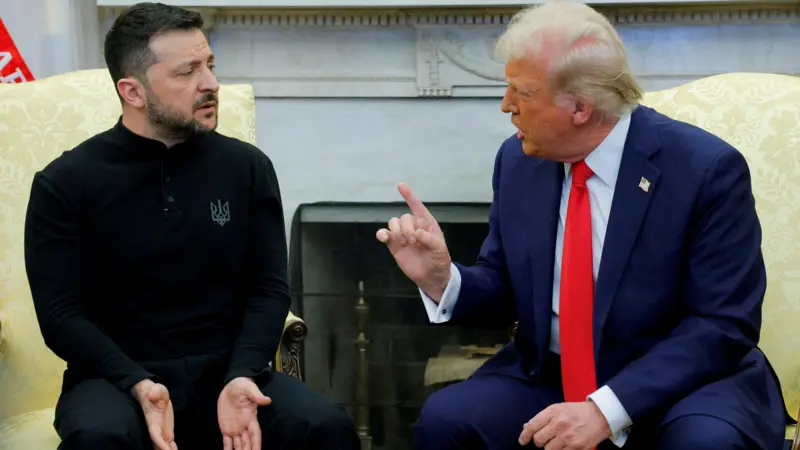
Hours before a high-stakes White House meeting with Ukrainian President Volodymyr Zelensky, U.S. President Donald Trump ruled out the prospect of Ukraine joining NATO and said Kyiv would not reclaim Crimea, the Black Sea peninsula annexed by Russia in 2014.
Trump insisted Zelensky could “end Russia’s war if he wants to,” signaling that any peace deal would require painful compromises from Kyiv. His remarks came as Zelensky arrived in Washington for negotiations joined by several key European leaders, underscoring the global stakes in determining Ukraine’s future.
Trump Signals Limits of U.S. Backing
Trump’s special envoy, Steve Witkoff, revealed that Russia had agreed to allow the U.S. and its European allies to extend “robust” security guarantees to Ukraine—potentially a NATO-style defense pledge without formal membership.
“It was agreed at the Alaska summit that the U.S. and Europe could effectively offer Article 5-like language to cover a security guarantee,” Witkoff told CNN, referencing NATO’s core clause that considers an attack on one member an attack on all.
Zelensky hailed the proposal as “historic,” while European allies, described as a “coalition of the willing,” pledged to help secure Ukraine’s skies and seas and assist in rebuilding its armed forces once the war ends.
Crimea at the Heart of Peace Talks
The future of Crimea remains a flashpoint. Russia seized the peninsula in 2014 after deploying masked troops and orchestrating a controversial referendum widely dismissed as illegitimate.
Ukraine’s constitution explicitly forbids ceding territory without a national referendum, and Zelensky has repeatedly rejected the idea of abandoning Crimea. “There’s nothing to talk about here,” he said earlier this year. “This is against our constitution.”
Trump’s comments, however, suggest Washington is unwilling to press Moscow to return Crimea, setting the stage for a potential clash with Kyiv.
Lessons From History
Analysts note that this is not the first time Ukraine has been offered security assurances. The 1994 Budapest Memorandum, signed by the U.S., U.K., and Russia, guaranteed Ukraine’s sovereignty in exchange for giving up nuclear weapons. Two decades later, Russia invaded Crimea and launched its full-scale war in 2022, rendering those guarantees meaningless.
Still, Trump’s envoys insist the proposed pact is different. “The United States is potentially prepared to give Article 5 security guarantees, but directly from the U.S. and European countries, not NATO,” Witkoff said. “That is big. I mean, really big.”
A Crucial Day in Washington
European leaders—including U.K. Prime Minister Keir Starmer, French President Emmanuel Macron, German Chancellor Friedrich Merz, and Italian Prime Minister Giorgia Meloni—will join Zelensky at the White House. NATO Secretary General Mark Rutte and European Commission President Ursula von der Leyen are also in attendance, underscoring the breadth of support for Kyiv.
The official schedule begins at noon EST with bilateral and multilateral meetings stretching into the afternoon.
Zelensky, who clashed with Trump in February during a heated Oval Office exchange, is expected to adopt a more conciliatory tone this time, while emphasizing that Ukraine must be directly involved in shaping any peace settlement.
“I’m confident we will defend Ukraine,” Zelensky said in a statement. “I hope that our joint strength with America, with our European friends, will force Russia into a true peace.”
Russian Strikes Continue
Even as leaders gather in Washington, Russian attacks persist. Overnight strikes on Kharkiv killed at least four people, including a child, while bombings in Zaporizhzhia left one dead and several injured. The assaults underscored the urgency of securing a deal that not only halts the war but guarantees Ukraine’s long-term security.
The Stakes
For Trump, today’s summit offers an opportunity to broker what he hopes will be a legacy-defining peace deal. For Zelensky and his European allies, it is a test of whether the U.S. is willing to stand firmly behind Ukraine’s sovereignty—or pressure Kyiv into concessions that could reshape Europe’s security for decades.
As one European diplomat put it ahead of the talks: “The world will be watching to see whether Washington defends Ukraine—or rewards Moscow.”
