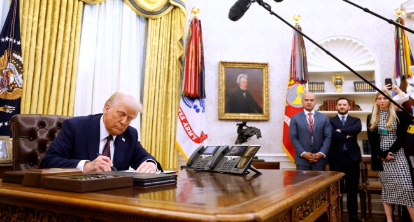
U.S. President Donald Trump on Tuesday signed an executive order withdrawing the United States from several United Nations (UN) bodies, including the UN Human Rights Council (UNHRC) and the United Nations Relief and Works Agency for Palestine Refugees (UNRWA). The order also mandates a broader review of U.S. funding for the UN, including its participation in UNESCO.
According to White House staff secretary Will Scharf, the move was in response to what the administration sees as “anti-American bias” within these organizations.
“More generally, the executive order calls for a review of American involvement and funding in the UN in light of the wild disparities and levels of funding among different countries,” Scharf stated.
The UNHRC, composed of 47 member states elected by the General Assembly, reviews human rights records worldwide. The U.S. ended its latest term on December 31, 2024, and held observer status before Trump’s order effectively ended all participation.
Trump has repeatedly criticized U.S. financial contributions to international organizations, demanding increased funding from other nations, similar to his stance on NATO.
Cuts to Palestinian Relief Agency
The order also reinforces the U.S. withdrawal from UNRWA, which provides aid to millions of displaced Palestinians. The Trump administration has backed Israel’s call to ban the agency, citing allegations that some employees were linked to Hamas.
U.S. funding for UNRWA was first suspended in January 2024 under then-President Joe Biden, following Israeli accusations that 12 UNRWA employees participated in Hamas’s October 7, 2023, attack. Independent investigations later found no evidence to support Israel’s main claims, leading many other donors to resume their financial support.
A Pattern of UN Withdrawals
This latest move is consistent with Trump’s first term policies, during which he pulled the U.S. out of the Paris Climate Accord and began withdrawing from the World Health Organization (WHO)—both of which he has resumed in his latest term.
Trump defended his decision, saying:
“The UN has tremendous potential, but it’s not being well run. It should be funded by everybody, but we’re disproportionate, as we always seem to be.”
The executive order signals a major shift in U.S. engagement with the UN and is expected to have significant diplomatic consequences in global governance and humanitarian aid.
