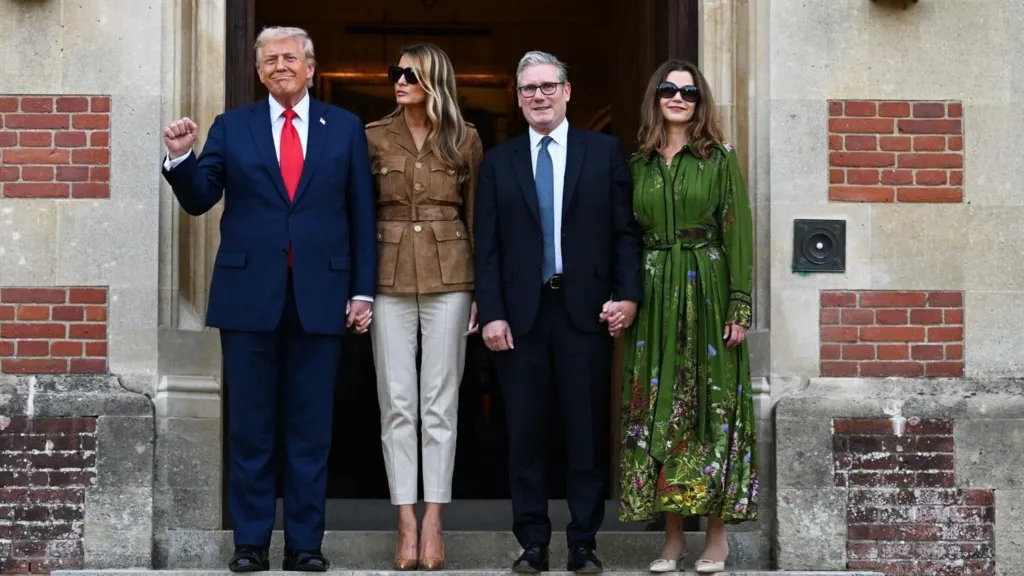
Donald Trump has suggested that Prime Minister Sir Keir Starmer could deploy the military to stop illegal migration, raising the stakes in Britain’s ongoing struggle to curb small boat crossings across the English Channel.
Speaking at a joint news conference marking the end of his second state visit to the United Kingdom, the US president said he had discussed migration issues with Starmer during a private meeting at the prime minister’s country residence, Chequers.
“You have people coming in and I told the prime minister I would stop it, and it doesn’t matter if you call out the military, it doesn’t matter what means you use,” Trump said.
He drew parallels between the UK’s migration challenges and the US southern border crisis, touting his own policies to secure America’s borders and deport undocumented migrants. In a subsequent interview with Fox News, Trump urged Starmer to take a “strong stand” against immigration, warning it was “hurting him badly.”
Trump has ramped up deportations and cracked down on unlawful crossings since returning to the White House in January. Arrests by the US Border Patrol have declined during his tenure, and he has issued executive orders broadly banning asylum for migrants entering through the southern border while deploying troops to assist with security.
Starmer, standing alongside Trump, said his government had been taking illegal migration “incredibly seriously.” He pointed to several migrant returns agreements signed with other countries, including France, and highlighted the first return under a new “one in, one out” scheme with France as “an important step forward,” while cautioning that “there’s no silver bullet here.”
More than 30,000 people have crossed the Channel in small boats so far this year — the earliest this figure has been reached since records began in 2018. The surge has intensified political pressure on Starmer to deliver a solution.
The leaders projected unity on migration policy but diverged on several other issues. Trump openly disagreed with Starmer’s plan to recognise Palestinian statehood ahead of next week’s UN General Assembly, accusing Hamas of “putting the hostages up as bait” and warning that illegal immigration “destroys countries from within.”
The two also faced questions on Ukraine, with Trump expressing disappointment in Russian President Vladimir Putin for refusing to engage in peace efforts. “He’s really let me down,” Trump said, urging Western allies to halt purchases of Russian oil to force Moscow to negotiate, though he stopped short of promising new sanctions.
The visit, filled with royal pomp and political theatre, saw Trump and First Lady Melania Trump welcomed at Windsor Castle by King Charles before attending a state banquet and meeting with Starmer at Chequers. The pair reaffirmed the “special relationship” between the UK and the US, announcing a new tech prosperity deal to boost cooperation on artificial intelligence, quantum computing, and other emerging technologies.
Still, the White House played down expectations that the visit would shift UK influence in trade or foreign policy. “None at all,” White House Chief of Staff Susie Wiles told the BBC when asked if it might. US Commerce Secretary Howard Lutnick suggested the AI investment deal could have been “ten times bigger” if Britain scrapped regulatory hurdles like the digital services tax and the Online Safety Act.
Departing from Stansted Airport on Air Force One shortly after the news conference, Trump left behind both warm words and sharp warnings — praising Starmer as a leader he “liked” but urging him to be far tougher on illegal migration and to “open up the North Sea” for oil and gas drilling to tackle what he called the UK’s “big energy problem.”
