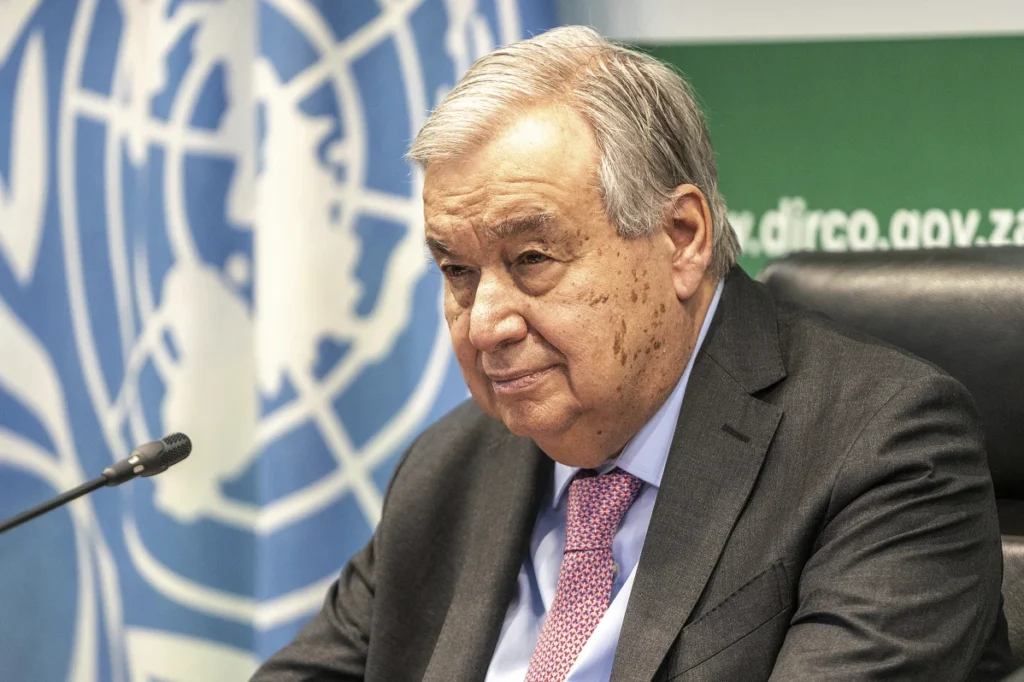
United Nations Secretary-General António Guterres has urged developed nations to fulfill their climate finance commitments to help vulnerable countries combat the effects of global warming. Speaking to Lesotho’s Parliament on Thursday during his visit to the small landlocked kingdom, Guterres also reiterated his call for Africa to gain permanent seats on the U.N. Security Council.
Guterres’ remarks come as part of a three-day visit to southern Africa, which included stops in South Africa and Lesotho. The trip highlights the region’s urgent climate challenges, exacerbated by severe droughts, and the financial shortfalls hindering global efforts to mitigate the crisis.
During his address, Guterres emphasized the critical need for developed nations to meet their promises to fund climate action in poorer countries. Referring to the $300 billion annual climate finance target agreed upon at U.N. climate talks in Azerbaijan last month, Guterres noted it falls far short of the $1 trillion requested by developing nations.
“Developed countries must meet their commitments and deliver the promised $300 billion annually for climate finance,” he said. He underscored the disproportionate impact of climate change on landlocked and least developed countries like Lesotho, which are particularly vulnerable to rising global temperatures.
Guterres also called for swift implementation and substantial funding of the newly established Loss and Damage Fund, designed to compensate poor nations for climate-related natural disasters.
Africa, which contributes only a small fraction of global greenhouse gas emissions, is among the continents most affected by climate change. Southern Africa is currently enduring one of its worst droughts in decades, triggering a hunger crisis impacting over 27 million people. Lesotho, like several neighboring countries, has declared a national disaster due to widespread crop failure.
Guterres noted the devastating impact of climate change and natural phenomena like El Niño, which has compounded challenges in the region. A recent World Meteorological Organization report revealed that African nations lose up to 5% of their GDP annually due to climate change.
Addressing the U.N. Security Council’s structure, Guterres reiterated his support for Africa’s inclusion as permanent members, calling the current system an outdated “relic of colonialism.” He expressed hope that at least two African nations would gain permanent seats on the Council before his term ends in December 2026.
“When a continent that is home to nearly a fifth of humanity remains systematically excluded from global decision-making, we must call this what it is: a relic of colonialism that has no place in today’s world,” Guterres said.
On Friday, Guterres is set to visit the Katse Dam, part of the Lesotho Highlands Water Project. The ambitious initiative involves building a network of dams and tunnels to channel water from Lesotho into South Africa, easing water shortages in the region. The project exemplifies how Lesotho is leveraging its natural water resources to address regional water security challenges.
Guterres’ visit underscores the urgent need for global solidarity in tackling climate change, supporting vulnerable nations, and rectifying systemic inequities in global governance.