Diplomats at the United Nations Security Council expressed broad support on Wednesday for transforming Haiti’s Multinational Security Support (MSS) mission into a formal U.N. peacekeeping mission to address escalating gang violence. However, Russia and China firmly opposed the proposal, citing concerns about the legitimacy of Haiti’s leadership and the current lack of stability in the country.
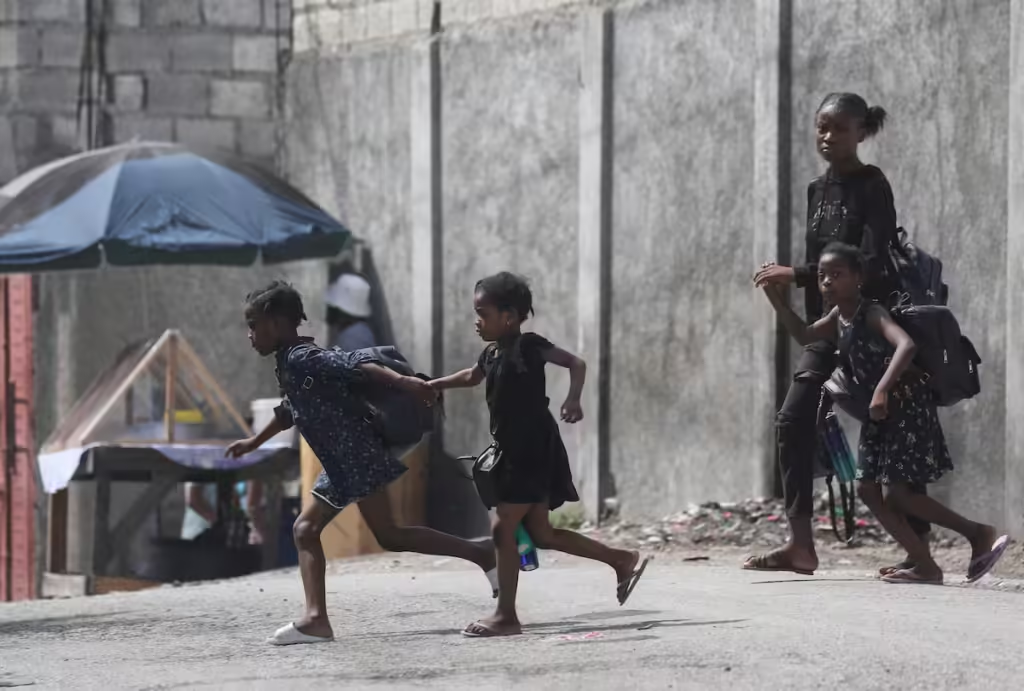
Haiti’s security crisis has worsened dramatically in recent weeks, with gangs shooting at commercial planes, halting flights into the country, and extending violence to areas of the capital previously untouched. The crisis has also led to the replacement of the prime minister, further exacerbating political turmoil.
Haitian leaders have repeatedly called for the MSS mission, which partially deployed in June, to be upgraded to a peacekeeping operation to ensure adequate funding and resources. The United States and Ecuador circulated a draft resolution to that effect in September, but the proposal was dropped due to opposition from Russia and China.
During Wednesday’s meeting, most Security Council members expressed support or openness to the idea, which would require a formal recommendation from U.N. Secretary-General António Guterres. Russia and China, however, argued that Haiti’s current political instability and unelected leadership made a peacekeeping mission premature.
Russia and China emphasized the importance of strengthening the existing MSS mission, which they said was underfunded and under-resourced.
Haiti’s U.N. Ambassador Antonio Rodrigue highlighted the dire situation on the ground, stating, “The financial, human, and logistical resources are currently completely insufficient to respond to the scale of the threat.” He added that the MSS mission, while well-intentioned, lacked the capacity to address Haiti’s deepening security crisis.
The MSS mission, approved in October 2023, deployed only 400 Kenyan troops—far fewer than the 3,100 pledged by participating nations. Its dedicated fund holds less than $100 million, a fraction of what is needed to tackle the crisis effectively.
Rodrigue stressed that any future peacekeeping mission must avoid the mistakes of past U.N. interventions in Haiti, which were marred by human rights abuses and the introduction of a cholera epidemic that claimed thousands of lives.
Jean “Bill” Pape, a prominent Haitian infectious disease expert, painted a grim picture of the worsening conditions. He described a surge in resignations from his health organization as employees fled the violence, and he made a heartfelt plea to the council: “It is a difficult task for any Haitian to request foreign troops on our own soil. But if nothing is done, the alternative will be a massive genocide that has started already, something only you have the power to prevent.”
The debate over Haiti’s security response continues as the MSS mission struggles to fulfill its mandate, and the international community wrestles with how best to assist the embattled Caribbean nation.
