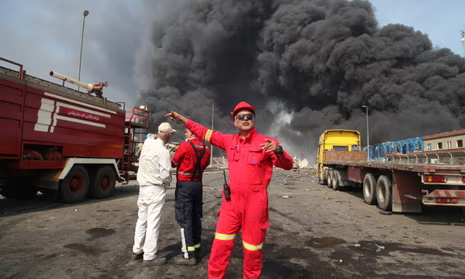
The death toll from the massive explosion at Iran’s largest commercial port has risen to 28, Red Crescent chief Pirhossein Koolivand said on Sunday, providing an update to earlier figures reported by state media.
“Unfortunately, 28 people have so far died,” Koolivand said in a video published on the Iranian government’s official website. He added that some of the more than 1,000 injured in the Shahid Rajaee Port blast on Saturday had been transferred to Tehran for urgent medical treatment.
Fires were still burning Sunday, following the powerful explosion that tore through Shahid Rajaee Port, located in southern Iran near the vital Strait of Hormuz — a strategic waterway through which about 20% of the world’s oil supply passes.
Possible Cause of Shahid Rajaee Port Explosion
According to a statement from the port’s customs office, broadcast by state television, the blast likely resulted from a fire in the hazardous and chemical materials storage depot. A regional emergency official also confirmed that several containers had exploded.
The New York Times, citing a source connected to Iran’s Islamic Revolutionary Guard Corps, reported that the material involved was likely sodium perchlorate — a key ingredient used in missile solid fuel.
Iranian news agency Tasnim, quoting the provincial judiciary chief, earlier reported 25 fatalities, while state TV stated that around 800 individuals were injured.
As of Sunday, updated figures confirmed more than 1,000 injuries.
Live footage showed thick black smoke still visible at the site nearly 20 hours after the initial explosion.
“The fire is under control but still not out,” a state TV correspondent reported live from Shahid Rajaee Port.
The blast was so intense that it was felt and heard up to 50 kilometers (30 miles) away, according to Fars News Agency.
Emergency Response and Recovery Efforts
Speaking at the scene on Sunday, Interior Minister Eskandar Momeni stated that “the situation has stabilised in the main areas” of the port. He also told state TV that operations, including container loading and customs clearance, had resumed.
Photos published by IRNA showed widespread devastation: rescuers and survivors walking among debris-strewn boulevards, flames engulfing trucks, and helicopters dousing massive plumes of smoke. Bloodstained vehicles and destroyed port facilities underscored the blast’s sheer impact.
“The shockwave was so strong that most of the port buildings were severely damaged,” Tasnim News Agency reported.
Mourning Declared After the Explosion in Iran
Local emergency services reported that hundreds of casualties were transferred to nearby hospitals, while the provincial blood transfusion center called for urgent blood donations.
Because Saturday marks the start of the workweek in Iran, the port was busy when the explosion occurred.
Among the injured were three Chinese nationals, who sustained light injuries, according to China’s CCTV, citing its consulate in Bandar Abbas.
Iranian President Masoud Pezeshkian expressed condolences to the victims and their families, announcing an investigation into the cause of the Shahid Rajaee Port explosion.
Regional neighbors also offered sympathy:
- The United Arab Emirates expressed “solidarity with Iran.”
- Saudi Arabia sent official condolences.
Due to hazardous air quality, authorities closed all schools and offices in Bandar Abbas on Sunday. Residents were urged to stay indoors and wear protective masks until further notice.
Officials declared three days of public mourning across Hormozgan province.
The National Iranian Oil Products Distribution Company clarified that the explosion “has no connection” to its nearby facilities, and that oil distribution operations in Bandar Abbas remain unaffected.
Broader Context: Tensions and Ongoing Talks
The Iran explosion comes at a sensitive time, as Iranian and US delegations are currently engaged in nuclear program discussions in Oman, with reported progress.
While authorities are treating the Shahid Rajaee Port blast as an accident for now, the incident occurs against a backdrop of heightened regional tensions. Notably, the Washington Post reported that Israel targeted the same port with a cyberattack in 2020.
