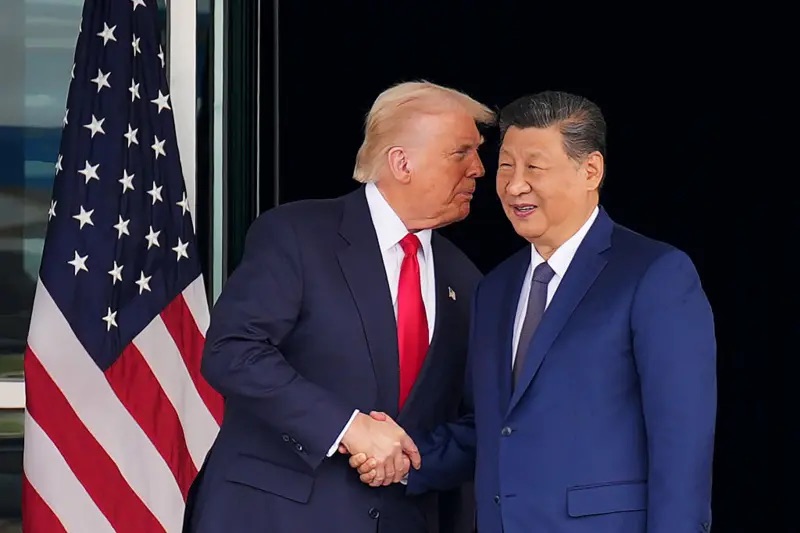
US President Donald Trump and Chinese President Xi Jinping met in the South Korean port city of Busan on Thursday, holding their first face-to-face talks in six years in a high-stakes effort to de-escalate a trade war that has disrupted global supply chains and economic stability.
The meeting, held on the sidelines of the Asia-Pacific Economic Cooperation (APEC) summit, saw both leaders adopt a cordial, if cautious, tone as they sought to stabilise relations between the world’s two largest economies. The dialogue resulted in a tentative agreement to reduce trade barriers and increase cooperation on critical issues.
As the leaders greeted each other on the red carpet, President Trump offered a handshake, saying, “Good to see you again,” but quickly signalled the tough negotiations ahead. The US President described his counterpart as “a very tough negotiator.” Despite the acknowledged tension, Trump predicted a “fantastic relationship for a long period of time,” concluding: “We’ll have a great understanding.”
President Xi, speaking through a translator, struck a conciliatory note. He acknowledged the reality of strained relations, stating that while China and the US “do not always see eye to eye, this is normal”, adding that it was “normal for economies to have frictions”. He emphasised that the two nations “should be partners and friends” and linked China’s progress to American prosperity, remarking that China’s development “goes hand in hand with the vision to make America great again”.
The talks, which lasted nearly two hours, covered a wide range of disputes, including tariffs, technology exports, and critical minerals. A key breakthrough was announced concerning the fentanyl crisis devastating American communities. Mr. Trump indicated that the US would lower a 20 per cent tariff on fentanyl-related Chinese goods to 10% in exchange for stronger Chinese cooperation on curbing the flow of precursor chemicals. Furthermore, the leaders reportedly reached a one-year agreement to remove the “roadblock” on rare earth elements, essential minerals for high-tech manufacturing, with Beijing also agreeing to resume purchases of US soybeans.
The Nuclear Backdrop
The summit’s cordial atmosphere was preceded by an abrupt move from the US President that underscored the deep strategic rift between the powers. Minutes before the talks began, Mr. Trump announced on social media that he had ordered the Pentagon to immediately begin nuclear weapons testing “on an equal basis” with China and Russia, an unexpected statement that raised global concerns about a new arms race.
Despite the successful conclusion of the bilateral meeting, analysts suggest the agreements represent a temporary truce focused on short-term stability rather than a complete resolution of the long-term strategic rivalry between Washington and Beijing. Mr. Trump reportedly told reporters after the summit that he “could sign a trade deal today” and that the leaders “have already agreed to a lot of things.”
