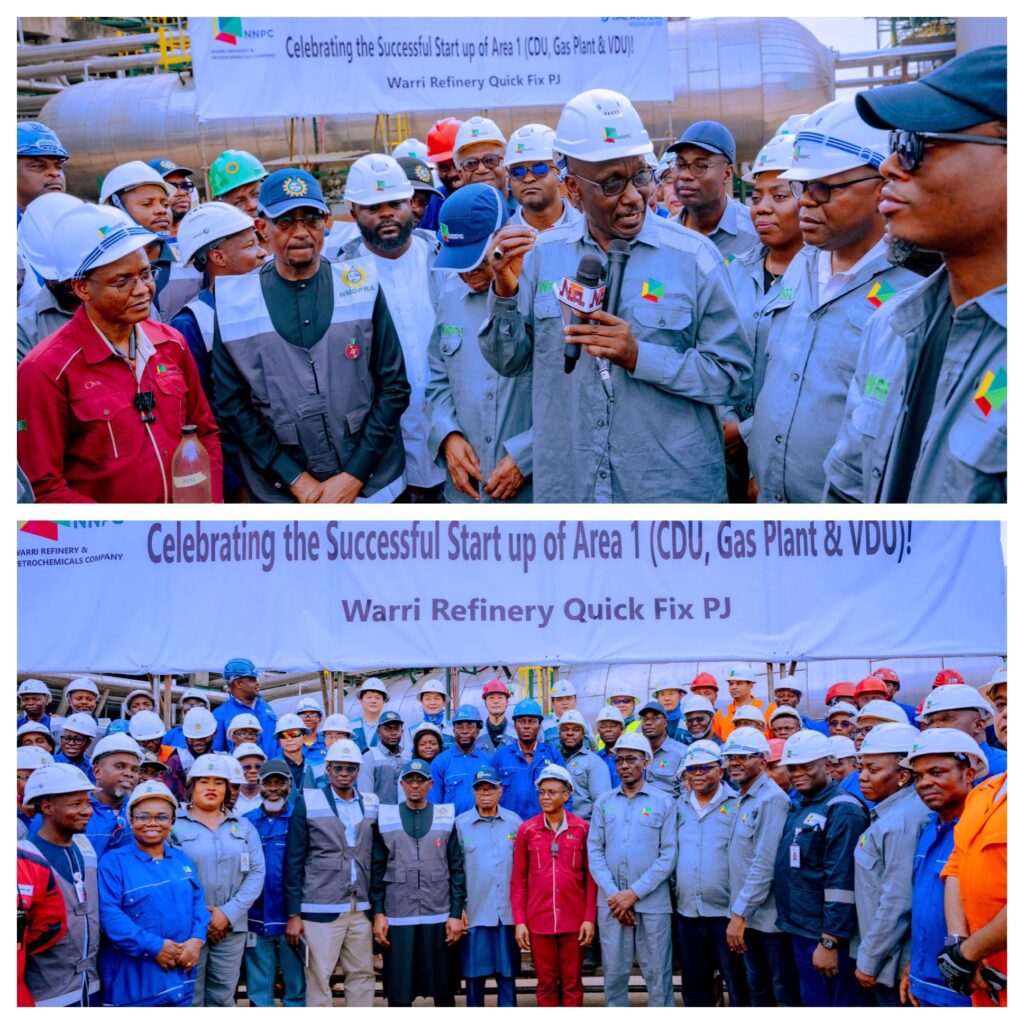
The Warri Refinery, with a capacity of 125,000 barrels per day (bpd), is now operational at 60% capacity, processing 75,000 bpd. This was disclosed by the Group Chief Executive Officer of the Nigerian National Petroleum Company Limited (NNPCL), Mele Kyari, during a facility tour on Monday.
Kyari highlighted the progress achieved in reviving the refinery, emphasizing the dedication and expertise of the NNPCL team and contractors. “We are taking you through our plant. This plant is running. Although it is not 100% complete, we are still in the process. Many people think these things are not real. We want you to see that this is real,” he said.
He revealed that the plant’s initial phase, Area 1, has commenced operations, producing high-demand petroleum products, including diesel (AGO), kerosene, and naphtha. These products are set to address domestic needs and generate export revenue.
“This country will make money to meet the promises of Mr. President that we will become an exporter of petroleum products. We have proven it is possible to restart a plant that was deliberately shut down,” Kyari stated.
The Warri Refinery is one of three major refineries under the NNPCL’s management, alongside the Port Harcourt Refining Company and the Kaduna Refining and Petrochemical Company. Kyari noted that efforts to revive these facilities align with the federal government’s commitment to ensuring self-sufficiency in petroleum production.
The Port Harcourt Refinery recently commenced refining 60,000 bpd, while the Kaduna Refinery is undergoing rehabilitation, with Kyari promising a “surprise” upon its completion.
The Warri Refinery, located in Ekpan, Uvwie, and Ubeji areas of Delta State, also houses a petrochemical plant producing 13,000 metric tons per annum (MTA) of polypropylene and 18,000 MTA of carbon black.
Originally commissioned in 1978, the refinery was built to serve markets in southern and southwestern Nigeria. The ongoing rehabilitation, which began with a mechanical completion target for the first quarter of 2024, underscores the government’s determination to restore Nigeria’s refining capacity.
The facility tour included officials such as Farouk Ahmed, CEO of the Nigerian Midstream and Downstream Petroleum Regulatory Authority (NMDPRA), highlighting the collaborative effort driving the refinery’s revival.
The progress at Warri and other refineries represents a significant step toward achieving energy security and reducing Nigeria’s dependence on imported petroleum products.
