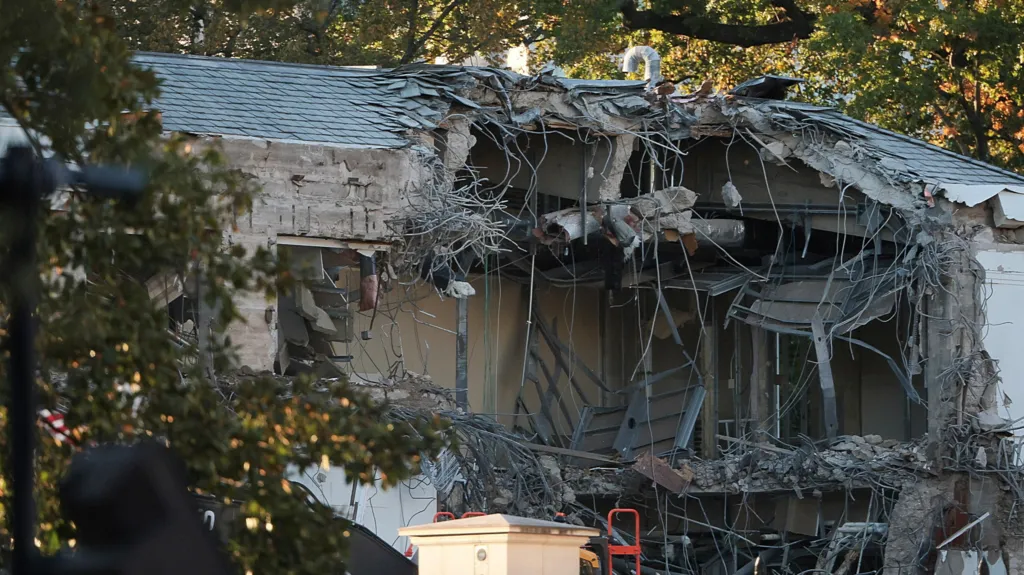
Construction crews have begun demolishing parts of the White House’s East Wing to pave the way for a new presidential ballroom championed by former U.S. President Donald Trump. Heavy machinery and cranes were seen tearing down sections of the covered entryway and windows on Monday as the ambitious $250 million project officially kicked off.
Trump said the White House expansion is part of a broader effort to “fully modernize” the East Wing, calling the addition “a long-overdue enhancement” to America’s most famous residence.
“The ballroom will be near the existing structure but will not touch it,” Trump said in July. “It won’t interfere with the current building. It pays total respect to the existing building, which I’m the biggest fan of. It’s my favorite place. I love it.”
Trump announced the project on social media, declaring that “ground has been broken” on the “much-needed” ballroom space. “For more than 150 years, every President has dreamt about having a Ballroom at the White House to accommodate people for grand parties, State Visits, etc,” he wrote.
The East Wing, originally constructed in 1902 and last modified in 1942, now shows visible signs of demolition. Photos from the site reveal large chunks of the facade missing, piles of concrete debris, and metal cables strewn across the entryway as cranes hover nearby.
Trump has said the project will be privately funded by “many generous Patriots,” though the White House has not disclosed the donors’ identities.
While the White House and surrounding parks are administered by the National Park Service (NPS), the president retains wide authority to make renovations. Still, the move has stirred controversy among historians and preservationists.
“There has been controversy with anything going on related to the White House pretty much since it was built,” said Robert K. Sutton, former chief historian of the NPS. He noted that no standard review process appears to have been completed. “This building is so important. It’s considered, I think, to be the most important executive building in the world – yet we just don’t know what’s happening, and I think that’s very inappropriate.”
Sutton added that capacity estimates for the new ballroom range from 600 to 900 guests. Renderings released by the White House suggest a grand interior with gold chandeliers and seating for hundreds.
According to the administration, construction officially began in September after Trump met with representatives from the National Park Service and the U.S. Secret Service. Clark Construction is leading the project, with McCrery Architects handling the design. The Secret Service will “provide the necessary security enhancements and modifications,” the White House said.
“I am honored that President Trump has entrusted me to help bring this beautiful and necessary renovation to The People’s House, while preserving the elegance of its classical design and historical importance,” said Jim McCrery, head of McCrery Architects.
Critics argue that the project risks altering the building’s historic character. The Society of Architectural Historians expressed “great concern” over the proposed additions, noting that this will be the first major change to the White House’s exterior in over eight decades. “Such a significant change to a historic building of this import should follow a rigorous and deliberate design and review process,” the organization said.
The American Institute of Architects has also urged transparency in the project’s approval and oversight.
Despite the backlash, Trump is far from the first president to leave his mark on the White House. President Barack Obama converted the tennis court to also host basketball games. Richard Nixon transformed the indoor swimming pool—installed in 1933 for Franklin D. Roosevelt—into the White House Press Room, where journalists still gather today. Gerald Ford later added an outdoor pool in 1975.
Perhaps the most extensive renovation occurred during Harry Truman’s presidency, when the entire White House was gutted and rebuilt between 1948 and 1952.
Still, Sutton worries the current changes reflect Trump’s personal style more than the nation’s legacy. “It’s always been called the People’s House,” he said.
As construction continues, the East Wing’s transformation stands as one of the most controversial and closely watched White House projects in decades—one that may redefine both its architecture and its symbolism for generations to come.