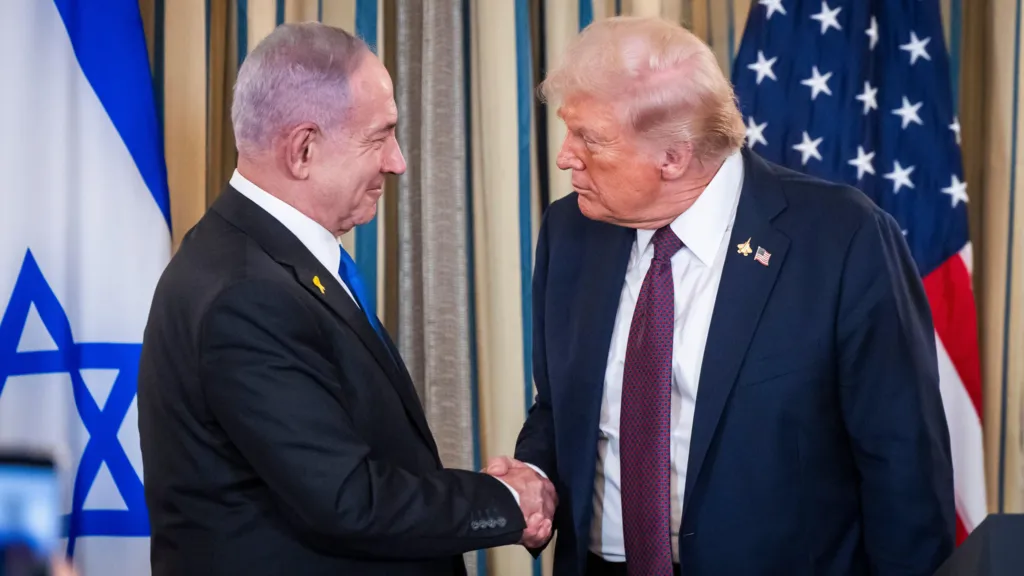
European and Middle Eastern leaders have welcomed a new US peace initiative for Gaza, as President Donald Trump urged Hamas to accept the deal or face continued Israeli military action.
The plan, announced Monday at the White House alongside Israeli Prime Minister Benjamin Netanyahu, outlines a 20-point framework for ending the Gaza war. It calls for an immediate halt to hostilities, the release within 72 hours of 20 Israeli hostages still alive and the remains of more than two dozen believed dead, in exchange for the release of hundreds of Palestinians held in Israeli prisons.
According to Palestinian officials, the document has been delivered to Hamas leaders in Doha. The plan stipulates that Hamas will play no role in Gaza’s future governance and leaves open the possibility of a Palestinian state — a prospect Netanyahu quickly dismissed.
Calling the deal “a historic day for peace,” Trump said the US would fully back Israel to “finish the job of destroying the threat of Hamas” if the group rejected the offer. Netanyahu echoed that stance, vowing Israel “will finish the job” if Hamas fails to comply. Later, he reiterated his opposition to a Palestinian state and insisted Israeli forces would remain in Gaza, contradicting parts of the written proposal.
The Palestinian Authority praised what it described as Trump’s “sincere and determined” efforts, pledging to work with Washington, regional states, and partners to secure aid delivery, hostages’ release, and a lasting ceasefire.
Regional powers including Saudi Arabia, Qatar, Egypt, Jordan, Turkey, Indonesia, and Pakistan issued a joint statement welcoming Trump’s leadership and endorsing the plan as a step toward a two-state solution with Gaza fully integrated into the West Bank. European Council President Antonio Costa called the moment “encouraging,” urging all parties to “give peace a genuine chance.”
UK Prime Minister Sir Keir Starmer also voiced support, saying Hamas should now accept the deal and “end the misery.” French President Emmanuel Macron offered to contribute to peace efforts, while Italy’s Prime Minister Giorgia Meloni said the proposal “could represent a turning point.”
The White House document envisions a technocratic Palestinian committee to govern Gaza temporarily, overseen by an international body dubbed the “Board of Peace” chaired by Trump. Former UK Prime Minister Tony Blair has been named to the panel, describing the plan as “bold and intelligent.”
Much of the plan focuses on rebuilding Gaza through what the US calls an “economic development plan.” It rules out permanent Israeli occupation or annexation and encourages Palestinians to remain in Gaza to “build a better future.”
Still, Hamas officials say any agreement must guarantee a full Israeli withdrawal and safeguard Palestinian interests. A senior Hamas figure told the BBC that “the weapons of the resistance are a red line” unless a political solution ensures an independent Palestinian state based on 1967 borders.
The announcement comes against the backdrop of mounting casualties and international criticism of Israel’s military campaign. Since October 2023, at least 66,055 people have been killed in Gaza, according to the Hamas-run health ministry. A UN-backed inquiry recently determined that famine was occurring in Gaza City, while a separate UN commission accused Israel of genocide — an allegation Israel strongly denies.
The Israeli offensive began after the October 7 Hamas-led assault that killed about 1,200 people in southern Israel and saw 251 hostages taken. The conflict has since drawn widespread condemnation, with dozens of diplomats staging a walkout during Netanyahu’s fiery speech at the UN General Assembly last week.
Despite Trump’s close alliance with Netanyahu, tensions have emerged in recent weeks. The US president reportedly expressed frustration over an Israeli strike in Qatar that killed a Qatari serviceman, an incident that drew sharp criticism from one of Washington’s closest Gulf allies.
Whether Trump’s plan can break the deadlock remains uncertain. Support from Europe and key Arab states signals rare diplomatic momentum, but Hamas’s insistence on Palestinian sovereignty — and Netanyahu’s rejection of a two-state solution — highlight the deep obstacles to lasting peace.
