Indirect talks aimed at securing a final agreement on a U.S.-brokered peace plan to end the Gaza war are set to continue Tuesday in the Egyptian resort city of Sharm El-Sheikh.
Palestinian and Egyptian officials told the BBC that discussions are focused on “creating the field conditions” for an exchange that could see all Israeli hostages released in return for a number of Palestinian prisoners.
Israeli Prime Minister Benjamin Netanyahu said on Saturday that he hoped to announce the release of hostages “in the coming days.”
As the officials met Monday, U.S. President Donald Trump told reporters at the White House, “We have a really good chance of making a deal, and it’ll be a lasting deal.”
Hamas has reportedly agreed in part to the U.S. proposals but has yet to respond to key demands, including disarmament and its exclusion from any future governance of Gaza. A senior Israeli security official said the talks would initially focus on the hostage release, allowing Hamas a few days to finalize that stage.
The second day of negotiations coincides with the second anniversary of the Hamas-led October 7, 2023 attack on southern Israel, which left about 1,200 people dead and 251 others taken hostage. Israel’s subsequent military campaign in Gaza has killed 67,160 people, including 18,000 children, according to the Hamas-run health ministry.
UN Secretary-General Antonio Guterres said Trump’s plan “presents an opportunity that must be seized to bring this tragic conflict to an end.” UK Prime Minister Sir Keir Starmer also backed the initiative, saying, “We welcome the U.S. initiative towards peace in the Middle East, and this government will do everything in our power to bring about the day where every child of Israel can live peacefully alongside their Palestinian neighbours.”
The high-stakes discussions—attended by U.S. envoy Steve Witkoff, Trump’s son-in-law Jared Kushner, and Qatari Foreign Minister Sheikh Mohammed bin Abdulrahman Al Thani—are expected to be among the most consequential since the war began.
Trump, posting on social media, urged negotiators to “move fast,” adding that the first phase of the peace plan, which includes the hostage release, “should be completed this week.” He told reporters Monday that “Hamas has been agreeing to things that are very important,” adding, “I really think we’re going to have a deal.”
A Palestinian official told Reuters the first session ended late Monday and would resume Tuesday. Egypt’s state-affiliated Al-Qahera News confirmed the continuation of talks “amid a positive atmosphere.”
The 20-point plan, developed by Trump and Netanyahu, calls for an immediate ceasefire and the release of 48 hostages—only 20 of whom are believed alive—in exchange for hundreds of detained Gazans. The plan stipulates that “full aid will be immediately sent into the Gaza Strip” once both sides agree, bars Hamas from governing Gaza, and keeps open the possibility of a future Palestinian state.
Despite this, Netanyahu reaffirmed his opposition to a Palestinian state, saying in a video statement, “It’s not written in the agreement. We said we would strongly oppose a Palestinian state.”
Hamas, in a Friday statement, said it agreed “to release all Israeli prisoners, both living and dead, according to the exchange formula contained in Trump’s proposal” if conditions are met. The group added it was open to handing Gaza’s administration to a technocratic Palestinian body backed by Arab and Islamic nations but made no mention of disarmament or a total withdrawal from governance.
The statement’s omission of Hamas’s usual “red lines” surprised many observers, suggesting possible external pressure.
The Palestinian Authority praised Trump’s efforts as “sincere and determined,” while even Iran, a longtime Hamas ally, signaled support for the peace initiative.
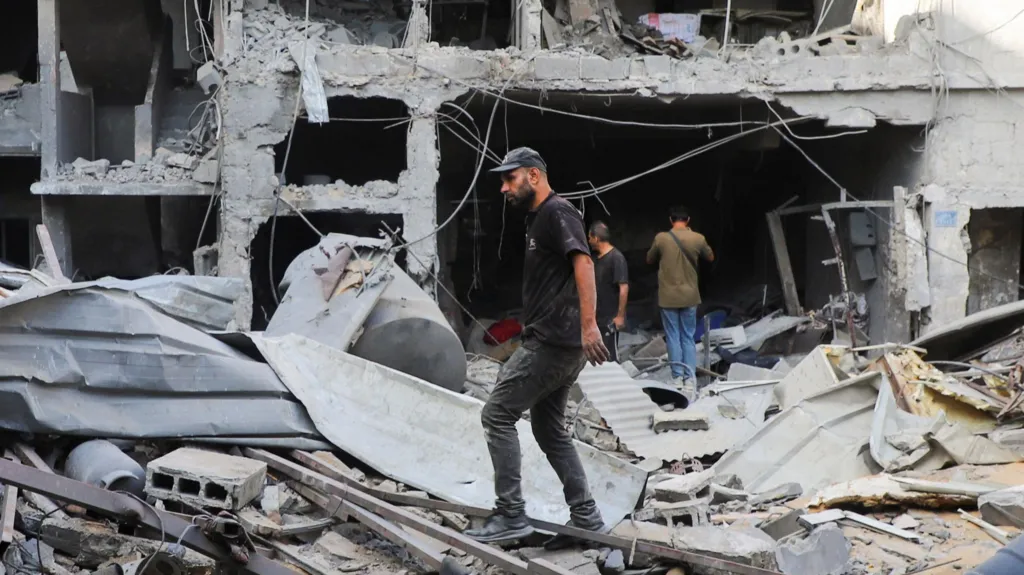
Meanwhile, Israeli bombardments continued across Gaza on Monday. Gaza Civil Defense spokesman Mahmoud Basal told the BBC that “no aid trucks have been allowed into Gaza City since the offensive began four weeks ago,” adding that bodies remain unrecovered from areas under Israeli control.
Thousands have fled Gaza City following evacuation orders to designated “humanitarian areas” in the south, though many remain trapped. Israel’s defense minister warned that anyone staying behind “would be considered terrorists and supporters of terror.”
The Hamas-run health ministry said 21 Palestinians were killed and 96 others wounded in the past 24 hours.
Since the start of the war, Israel has barred international journalists from independently entering Gaza, making verification of claims from both sides difficult.
