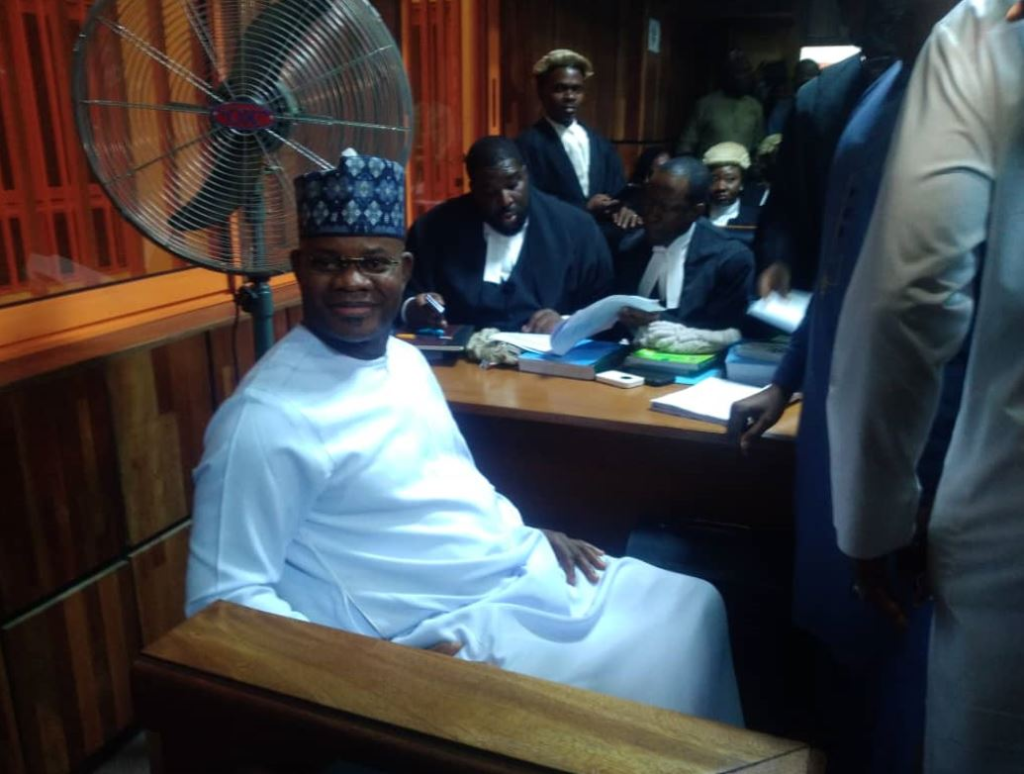
The trial of former Kogi State governor Yahaya Bello over alleged N110 billion money laundering continued on Wednesday at the high court of the federal capital territory (FCT), Maitama, Abuja, with new witnesses taking the stand. Bello, who governed Kogi from 2016 to 2024, is facing a 16-count charge alongside former officials Umar Shuaibu Oricha and Abdulsalami Hudu over alleged diversion of public funds.
Testifying as the third prosecution witness, Williams Abimbola, a compliance officer with United Bank for Africa (UBA), told the court that all transactions processed by the bank followed established financial regulations. She said the withdrawals linked to the Kogi government house account domiciled in Lokoja complied with banking procedures, adding that her duty was to safeguard the bank’s integrity and ensure regulatory compliance to avoid legal or reputational risk.
Under cross-examination by Bello’s counsel, J.B. Daudu, Abimbola confirmed that several withdrawals of N10 million each were made between July 31 and August 6, 2019, by one of the defendants, Hudu, but noted that a bank is not responsible for auditing a customer’s internal spending once a valid mandate is presented.
According to her, UBA also processed series of transfers from the same account on July 5, 2019, by one Bello Abdullateef. She stressed that none of the transactions exceeded the N10 million threshold and listed the authorised signatories on the account as of 2004 to include Christopher Enefola (permanent secretary), Onekutu Daniel (chief accountant), and Abdulsalami Hudu (accountant).
When questioned by counsel to the third defendant, A.M. Aliyu, she confirmed that a credit entry of N100 million described as “governor’s security fund” was paid into the account in two tranches of N50 million each. Asked if the money was actually used for security purposes, she responded, “My lord, I am not privy to the details of the transaction and cannot categorically answer that question”. She also stated that she never had any interaction with Bello or Oricha.
Following her testimony, the EFCC called its fourth witness, Jesutoni Akoni, a compliance officer with Ecobank, who appeared under subpoena. However, defence lawyers objected to a 13-page document Akoni intended to rely on, arguing that it was addressed to Emeka Nwite, judge of the federal high court where a related matter is pending. EFCC counsel Kemi Pinheiro subsequently withdrew the cover letter attached to the document.
Akoni told the court that he was not familiar with the three signatories to the Ecobank account under scrutiny and noted that Hudu’s name was not among them.
Bello’s counsel, Daudu, then informed the court that the defence had filed an application challenging the court’s jurisdiction and argued that hearing the motion first would “save the time of the court and that of the witnesses”. The EFCC opposed the request, insisting the application was not ripe for hearing.
Presiding judge Maryann Anenih adjourned the matter to Thursday for continuation of trial.
