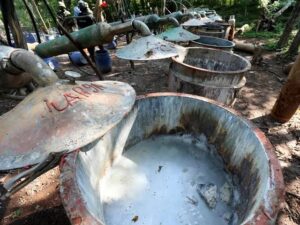
The National Drug Law Enforcement Agency (NDLEA) has raised fresh concerns over the emergence of clandestine methamphetamine laboratories concealed in forests across the country, warning that the development signals a dangerous shift in the operations of transnational drug trafficking networks and poses a growing threat to Nigeria’s security.
The anti-narcotics agency said criminal organisations are increasingly moving the production of illicit drugs to remote forest locations in a bid to evade law enforcement agencies, describing the trend as one of the most significant challenges confronting the country’s fight against drug trafficking.
NDLEA spokesperson, Femi Babafemi, disclosed this during a briefing by spokespersons of security, defence and law enforcement agencies at the National Counter-Terrorism Centre (NCTC), where he highlighted the agency’s operational achievements and emerging threats in the nation’s anti-drug campaign.
According to Babafemi, the agency recently dismantled what it described as the largest clandestine methamphetamine laboratory ever uncovered in Nigeria. The illegal facility was hidden deep inside Abidagba Forest in Ijebu East Local Government Area of Ogun State, where suspected members of an international drug syndicate allegedly operated beyond public scrutiny.
He said seven suspected members of the criminal network were arrested during the operation, while intelligence gathered from the raid led operatives to another location in Lakowe, Lekki, Lagos State. There, officers arrested the alleged leader of the syndicate, identified as Anochili Innocent, alongside three Mexican nationals believed to have travelled to Nigeria to provide technical expertise for the manufacture of methamphetamine.
Babafemi explained that investigations at the forest laboratory led to the recovery of about 2,419.48 kilograms of precursor chemicals, industrial solvents and finished methamphetamine. The seized materials, he noted, have an estimated international street value of about $362.9 million, equivalent to approximately ₦480 billion, making it one of the most valuable drug seizures recorded by the agency.
He described the discovery as evidence that international drug cartels are strengthening collaborations with local criminal elements, adopting more sophisticated methods to conceal their operations and frustrate security agencies.
According to him, the use of dense forests for industrial-scale drug production represents a new frontier in organised crime that requires sustained intelligence gathering and coordinated law enforcement responses.
Beyond the major breakthrough in Ogun and Lagos states, the NDLEA said it intensified enforcement operations across the country during the first five months of 2026. The agency reported the arrest of 9,769 suspected drug offenders between January and May, while 1,778 persons were successfully prosecuted and convicted for drug-related offences.
Among those convicted were 65 individuals identified by the agency as major drug barons.
The agency also sustained raids on locations identified as hubs for drug trafficking and abuse. In the Federal Capital Territory, operatives dismantled more than 15 notorious drug hotspots, resulting in the arrest of 132 suspects and the recovery of various illicit substances.
Similarly, Babafemi disclosed that anti-drug operations in Delta State led to the destruction of approximately 65,000 kilograms of cannabis cultivated on about 26 hectares of farmland hidden within forest reserves. He noted that the destruction of illicit cannabis farms remains a critical strategy in disrupting the supply chain of illegal drugs before they reach local and international markets.
While highlighting the agency’s enforcement successes, the NDLEA stressed that reducing drug demand remains an important component of its strategy. Babafemi said the agency provided counselling, treatment and rehabilitation services to 6,533 persons struggling with drug dependence during the review period.
He added that through its War Against Drug Abuse (WADA) campaign, the agency organised 2,252 sensitisation programmes across schools, markets, workplaces, religious centres and communities nationwide. According to him, the awareness campaigns reached an estimated 770,000 Nigerians and were aimed at educating citizens, particularly young people, on the dangers of drug abuse and trafficking.
The spokesperson also highlighted the agency’s efforts to address the root causes of illicit drug cultivation through alternative livelihood initiatives. He said the NDLEA launched an Alternative Development Pilot Project in January 2026 with support from the United Nations Office on Drugs and Crime (UNODC). The programme is designed to encourage communities involved in illegal cannabis cultivation to adopt legitimate agricultural activities capable of providing sustainable sources of income.
Babafemi maintained that the discovery of hidden methamphetamine laboratories in forests demonstrates the evolving tactics of organised criminal networks and underscores the need for stronger collaboration among security agencies, community leaders and international partners in combating drug trafficking.
He assured Nigerians that the agency would continue to strengthen intelligence-led operations, dismantle drug production facilities and disrupt trafficking networks, while expanding preventive programmes aimed at reducing drug abuse and protecting communities from the harmful effects of illicit substances. Visit www.jocomms.com for more news.
