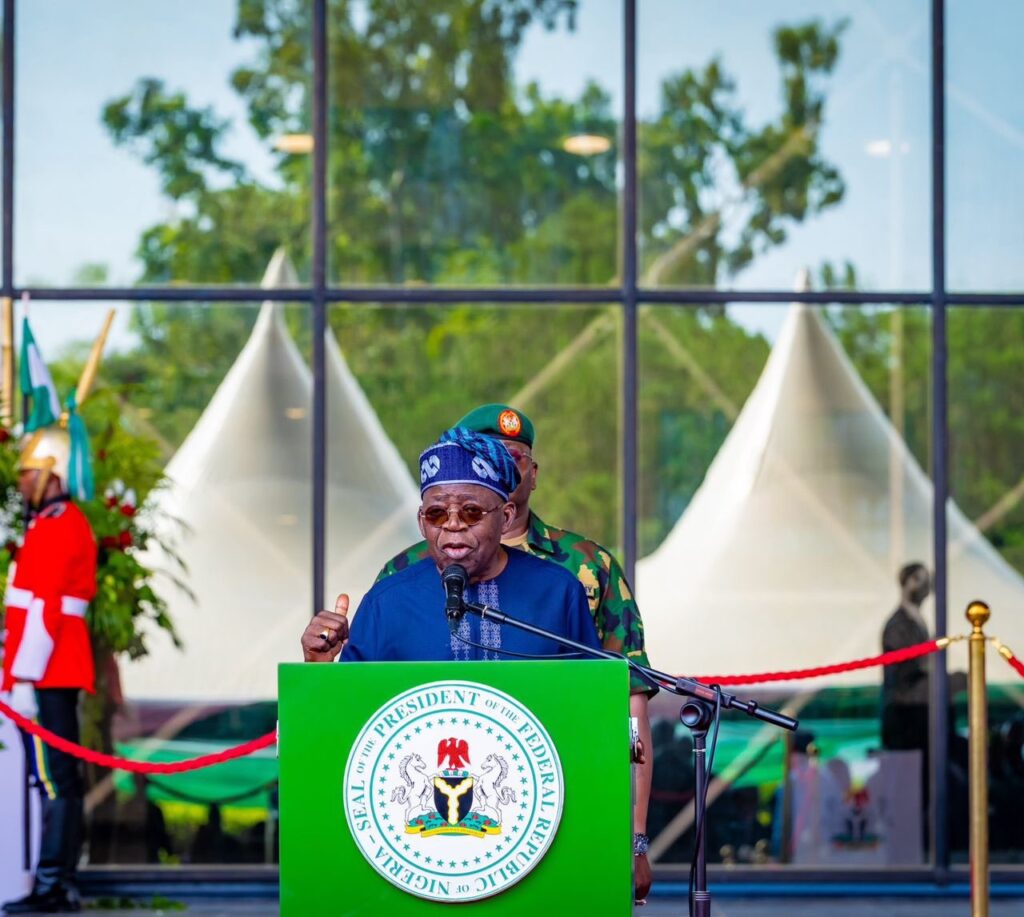
President Bola Ahmed Tinubu on Friday commissioned new and upgraded health facilities across Nigeria, marking what has been described as the largest single-day commissioning of federal health infrastructure projects in the country’s history.
The projects, spread across the six geopolitical zones, form part of activities marking the third anniversary of the Tinubu administration and are aimed at strengthening healthcare delivery, emergency response systems and access to quality medical services nationwide.
In Abuja, President Tinubu inaugurated the Bola Tinubu Specialist Complex at the Federal Medical Centre (FMC), Jabi. The modern two-storey facility features specialist consulting rooms, operating theatres, dedicated departments for ophthalmology and ENT services, a fully equipped laboratory, pharmacy, VIP wards and general wards designed to provide advanced healthcare services.
The President also flagged off the National Emergency Medical Service and Ambulance System (NEMSAS) Emergency Response Fleet at the Federal Ministry of Health and Social Welfare headquarters. The fleet includes 145 tricycle ambulances, six boat ambulances and 79 new emergency ambulances for federal tertiary hospitals, alongside digital equipment to support emergency coordination nationwide.
In Lagos, President Tinubu launched a fleet of Compressed Natural Gas (CNG)-powered ambulances for the country’s 73 federal tertiary health institutions. The initiative is expected to reduce operational costs, cut carbon emissions and improve emergency referrals between healthcare facilities.
As part of efforts to strengthen disease surveillance and immunisation programmes, the President commissioned upgraded Polio Emergency Operations Centres (PEOCs) in Kano, Katsina and Sokoto states. The facilities have been renovated and re-equipped to enhance outbreak response and public health coordination.
The President also commissioned the newly constructed Gadon Kaya Primary Health Centre in Kano State and the Aboh Primary Health Centre in Delta State under the World Bank-supported IMPACT Project, which has revitalised thousands of primary healthcare facilities across the country.
Other projects commissioned include a new Laboratory Complex at the University of Uyo Teaching Hospital in Akwa Ibom State, an Administrative Complex at the University of Nigeria Teaching Hospital in Enugu State and a Pharmacy Quality Control Laboratory at the Ahmadu Bello University Teaching Hospital in Zaria, Kaduna State.
In Maiduguri, Borno State, the President inaugurated a 50-bed Mental Health and Drug Rehabilitation Centre at the University of Maiduguri Teaching Hospital to address mental health challenges and substance abuse, particularly in conflict-affected communities.
The President further commissioned the Lagos Immunisation Supply Chain Hub in Oshodi, the first completed facility under Nigeria’s new Three-Hub Immunisation Supply Chain Model aimed at improving vaccine distribution across the South-West and South-South regions.
Speaking during the virtual commissioning ceremony, President Tinubu described the projects as part of the most ambitious healthcare infrastructure renewal programme in a generation.
He said the administration remains committed to ensuring that Nigerians have access to quality healthcare services and an effective emergency medical system regardless of their location.
The President commended the Federal Ministry of Health and Social Welfare, NEMSAS, development partners, state governments and healthcare institutions involved in the successful delivery of the projects.
According to figures released by the Ministry of Health, nearly 3,000 primary healthcare centres have been revitalised under the IMPACT programme over the past two years, while thousands of health facilities across the country have received upgrades under the Nigeria Health Sector Renewal Investment Initiative.
