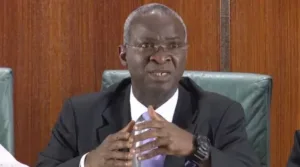
Former Lagos State Governor and Senior Advocate of Nigeria, Babatunde Fashola, has called for far-reaching security reforms, stronger law enforcement institutions, and improved governance, stressing that the rule of law remains the foundation for national stability, economic growth, and sustainable development.
Fashola made the call while delivering a keynote address at the opening ceremony of the 2026 Law Week of the Nigerian Bar Association (NBA) in Lagos. His remarks come at a time when Nigeria continues to grapple with security challenges, concerns over law enforcement effectiveness, and growing public demand for improved governance and accountability.
According to Fashola, no society can achieve meaningful progress without ensuring the security of lives and property.
He noted that governments must prioritize law enforcement and uphold the rule of law if they are to create an environment that encourages investment, innovation, and economic prosperity.
The former Minister of Works emphasized that the Nigerian Constitution clearly outlines the primary responsibility of government as ensuring the security and welfare of citizens. He argued that while political debates often focus on economic policies and infrastructure development, these objectives can only be fully realized when citizens feel safe and protected under a functioning legal system.
Fashola observed that countries that maintain strong legal institutions and effective security structures tend to enjoy higher levels of economic growth and public confidence. According to him, investors are more willing to commit resources to environments where laws are enforced consistently and where public institutions function effectively.
He urged governments at the federal, state, and local levels to move beyond policy pronouncements and focus on the implementation of existing laws. In his view, many of Nigeria’s challenges stem not from a lack of legislation but from weak enforcement mechanisms and inadequate institutional coordination.
Addressing members of the legal profession, Fashola challenged Attorneys-General and other senior legal officers to become more visible in conversations surrounding security and criminal justice.
He noted that legal authorities often remain silent during major criminal incidents, leaving the public without clear information on ongoing investigations and judicial processes.
He stressed that greater public engagement by legal institutions would help improve trust in the justice system and demonstrate that criminal acts are being addressed through lawful and transparent processes. He also called on legal practitioners to contribute more actively to policy discussions aimed at strengthening the country’s legal and security architecture.
The former governor further advocated stronger collaboration among the executive, legislature, judiciary, and law enforcement agencies. He argued that effective crime prevention and prosecution require a coordinated approach involving all relevant institutions. According to him, isolated efforts by individual agencies are often insufficient to address complex security threats facing the country.
As part of his argument for stronger law enforcement, Fashola highlighted the widespread use of vehicles without registration plates in many parts of Nigeria. He described the situation as a basic but significant failure of regulatory enforcement, noting that vehicle identification systems play a critical role in crime prevention and investigation.
He warned that allowing vehicles to operate anonymously creates opportunities for criminal activity and undermines the ability of security agencies to track suspects. He therefore called for stricter enforcement of existing vehicle registration regulations as part of broader efforts to improve public safety.
Beyond security, Fashola spoke extensively on governance and public administration.
He maintained that democracy alone does not automatically produce good governance, stressing that leadership must be guided by evidence, accountability, and responsiveness to citizens’ needs.
Drawing from his experience in public office, he emphasized the importance of data-driven decision-making. He explained that governments should regularly engage citizens through surveys, consultations, and other feedback mechanisms to better understand public priorities. Such information, he said, should guide budgeting decisions, policy formulation, and resource allocation.
Fashola also underscored the role of citizens in nation-building, noting that governance is a shared responsibility.
While government must provide security and essential services, citizens must also fulfill their obligations by obeying laws, paying taxes, and supporting efforts aimed at maintaining public order.
On judicial communication, the former governor advocated the use of simpler and more accessible legal language. He argued that many court decisions and legal documents remain difficult for ordinary citizens to understand, creating confusion and sometimes leading to misinformation. Simplifying legal communication, he said, would make the justice system more transparent and accessible to the public.
He concluded by urging legal professionals, policymakers, and public institutions to move beyond merely identifying national challenges and focus on implementing practical solutions.
Fashola also proposed the establishment of a task force that would develop actionable recommendations on legal reform, law enforcement effectiveness, regulatory compliance, and governance improvement.
According to him, Nigeria’s progress depends not only on policy discussions but on the willingness of institutions and stakeholders to translate ideas into measurable actions. He maintained that strengthening security, enforcing laws consistently, and improving governance standards would contribute significantly to national development and help build public confidence in democratic institutions.
His remarks add to ongoing national conversations on security sector reforms, judicial effectiveness, and governance accountability, issues that continue to dominate public discourse as the country seeks pathways toward sustainable development and long-term stability. Visit www.jocomms.com for more news.
