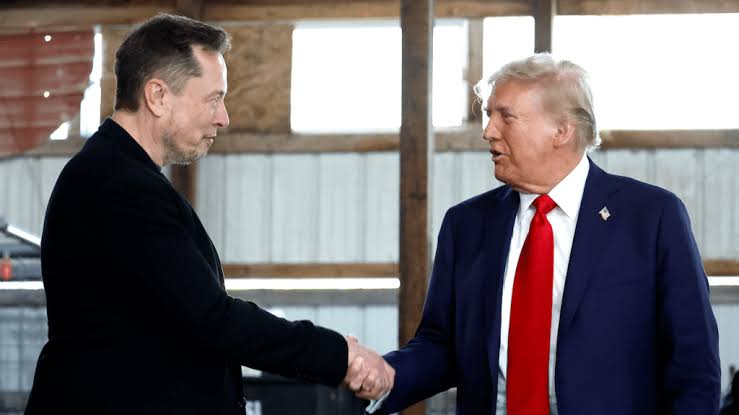
President-elect Donald Trump announced on Tuesday that Elon Musk will co-lead a newly established Department of Government Efficiency, a move that gives even more influence to the world’s wealthiest person, who had donated millions to Trump’s campaign. Musk will team up with Vivek Ramaswamy, a former Republican presidential candidate, in overseeing the new department, which Trump said would operate outside the typical structures of government.
In a statement, Trump explained that Musk and Ramaswamy’s roles will be crucial in helping his administration reduce bureaucracy, eliminate unnecessary regulations, cut wasteful spending, and reform federal agencies. He emphasized that the department would bring in “advice and guidance from outside of government,” effectively allowing Musk and Ramaswamy to work informally without requiring Senate confirmation. This setup would also enable Musk to continue leading his companies—Tesla, SpaceX, and X (formerly Twitter).
The Department of Government Efficiency will collaborate with the White House and the Office of Management and Budget to implement large-scale structural reforms and introduce an entrepreneurial approach to government, something Trump said has never been attempted before. The department’s work is set to conclude by July 4, 2026—the 250th anniversary of the signing of the Declaration of Independence.
Musk, who Forbes ranks as the richest person globally, stands to benefit from his close ties to Trump. The billionaire entrepreneur is already expected to exert considerable influence on policies that could favor his business ventures, including electric vehicles, space exploration, and emerging technologies like AI and cryptocurrency. Musk has been a vocal supporter of Trump, contributing millions of dollars to his campaign and making public appearances on his behalf.
Financial analysts, like Daniel Ives from Wedbush Securities, predict that Musk’s new role will be beneficial for both him and Tesla. “The major benefits for Musk and Tesla far outweigh any negatives,” Ives wrote, calling it a strategic “poker move for the ages.”
However, the move has sparked criticism from organizations like Public Citizen, a progressive watchdog group. Lisa Gilbert, co-president of Public Citizen, argued that Musk, whose companies have frequently clashed with regulations, is ill-suited to lead efforts to reduce government inefficiency. “This is the ultimate corporate corruption,” she said.
Trump has likened the government efficiency initiative to the Manhattan Project, which developed the atomic bomb during World War II. Musk, for his part, promised transparency for the new department, saying on X (formerly Twitter) that all actions of the department would be posted online, including a “leaderboard” for the most egregious examples of wasteful government spending. Musk had previously suggested that discretionary spending, including defense, could be reduced by as much as $2 trillion.
The department’s name—DOGE—also refers to the cryptocurrency Dogecoin, which Musk has famously supported. Dogecoin’s value has surged since Election Day, buoyed by speculation that a Trump administration might provide a friendlier regulatory environment for cryptocurrencies. Musk and Tesla recently won the dismissal of a federal lawsuit accusing them of defrauding investors with inflated claims about Dogecoin.
Shares of Tesla, which had dropped ahead of the announcement, have rebounded by approximately 30% since the election. Meanwhile, Ramaswamy has announced he is withdrawing from consideration for a U.S. Senate appointment in Ohio in order to focus on his new role in the Trump administration.
The move marks another significant step in Trump’s effort to reshape the government with a heavy emphasis on private-sector solutions and influence from business leaders like Musk.
