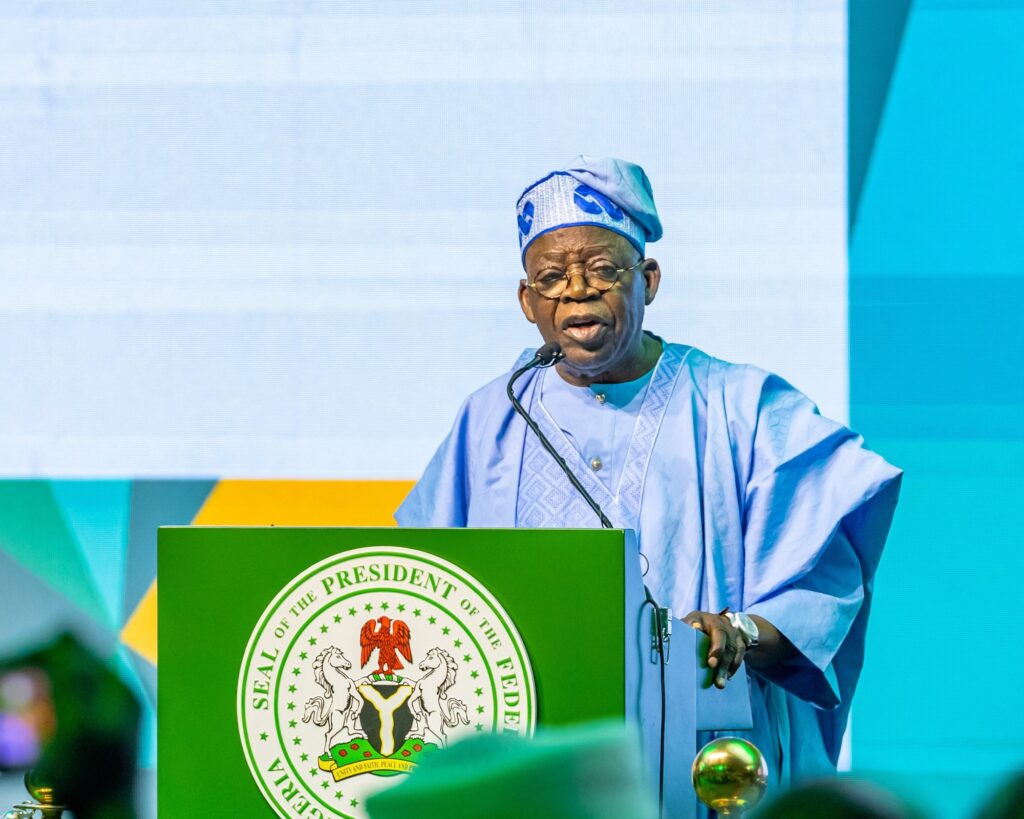
President Bola Ahmed Tinubu has delivered his 2026 Democracy Day address, declaring that while Nigeria’s democracy was secured by the generation of June 12, the current generation must focus on securing national prosperity.
Speaking on Friday, June 12, the President reflected on 27 years of uninterrupted civilian rule since 1999, describing Nigeria’s democratic journey as “not perfect, but ours,” and urging Nigerians to continue defending and strengthening democratic institutions.
He called on INEC, security agencies, political actors, civil society, and the media to ensure credible and peaceful elections in Ekiti and Osun States, stressing that democracy depends on public trust in the electoral process.
Security and national unity
President Tinubu acknowledged ongoing security challenges, including recent abductions in parts of Oyo and Borno States, while assuring Nigerians of intensified security operations and reforms.
He said his administration has declared a security emergency, recruited over 50,000 police officers, and committed ₦5.41 trillion to defence in the 2026 budget. He also highlighted ongoing counter-terrorism operations and claimed significant gains against insurgent groups, including the surrender of over 124,000 fighters under Operation Safe Corridor.
He issued a stern warning to criminals, saying they must surrender or face the full force of the Nigerian state, while urging Nigerians to remain united beyond ethnic and regional divisions.
Economic reforms and national growth
The President defended his administration’s economic reforms, describing them as necessary to restore stability, improve public finances, and rebuild investor confidence.
He said the reforms have strengthened fiscal transparency, increased federation revenues, and improved funding for states and local governments. According to him, investments have grown across agriculture, energy, manufacturing, technology, mining, transport, and the creative sector.
He also noted improvements in domestic refining capacity and ongoing efforts to reduce inflation, expand food production, create jobs, and improve living standards.
Power sector and infrastructure development
On electricity, the President said long-standing challenges in generation, transmission, and distribution had weakened the sector for years, but reforms are now underway.
He referenced the Electricity Act, which allows states to participate in power generation and distribution, and said a Presidential Power Sector Task Force is working to reduce metering gaps and stabilise the industry. He also noted plans to raise a ₦4 trillion bond to clear verified legacy debts.
He added that rural electrification projects, supported by international development partners, are expanding access to power in underserved communities, including schools, hospitals, and markets.
June 12 legacy and national recognition
President Tinubu paid tribute to the heroes of Nigeria’s democratic struggle, including M.K.O. Abiola, Kudirat Abiola, Gani Fawehinmi, Bola Ige, Frank Kokori, and several others who fought for the restoration of democracy.
He announced national honours for a list of individuals who contributed to pro-democracy activism, as well as recognition for selected military officers described as part of the June 12 democratic struggle.
He also announced the upgrade and renaming of the Institute of Petroleum Studies in Kaduna to the General Shehu Musa Yar’Adua University of Geological Sciences and Engineering Technology.
Closing message
The President concluded by calling for unity and collective purpose, urging Nigerians to reject division and despair.
He said while the June 12 generation secured democracy, the present generation must secure prosperity, adding that Nigeria’s diversity remains a strength.
“Let us move forward together… Nigeria does not break. We bend, we bleed, but we do not break,” he said.
He ended the address with a call for renewed commitment to democracy, justice, and national development.
