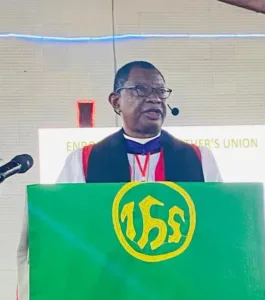
The Anglican Bishop of Enugu Ecclesiastical Province and Enugu Diocese, Rt. Rev. Prof. Samuel Obiajulu Ike, has called on the Federal Government to discontinue its policy of reintegrating repentant terrorists into society, insisting that individuals involved in terrorism should be prosecuted in accordance with the law rather than rehabilitated and returned to their communities.
The bishop made the call while delivering his presidential address during the third session of the 19th Synod of the Anglican Diocese of Enugu, held at St. Peter’s Anglican Church, Ogbete, Enugu. The synod brought together clergy, church leaders and delegates to deliberate on issues affecting the Church and the nation, with insecurity emerging as one of the major concerns highlighted during the gathering.
According to Bishop Ike, while rehabilitation may be appropriate for individuals guilty of lesser offences, those who have participated in acts of terrorism, including mass killings, kidnappings and the destruction of communities, should be subjected to due legal process to ensure justice for victims and their families.
He argued that the continued reintegration of repentant terrorists sends the wrong signal to Nigerians, particularly to communities that have suffered devastating attacks at the hands of insurgent groups. According to him, allowing former terrorists to re-enter society without adequate accountability undermines public trust in the country’s justice system and weakens confidence in the government’s efforts to combat insecurity.
The cleric stressed that justice must remain the cornerstone of every counterterrorism strategy, noting that victims deserve to see perpetrators held accountable for their crimes. He maintained that genuine peace can only be achieved when justice is served alongside security interventions.
Bishop Ike, however, commended President Bola Ahmed Tinubu for taking steps to strengthen Nigeria’s security architecture. He acknowledged the administration’s increased funding for the armed forces and other security agencies, describing the move as a positive step towards improving the country’s capacity to tackle terrorism, banditry and other violent crimes.
Despite these efforts, he urged the President to intensify actions aimed at completely dismantling terrorist networks operating across different parts of the country. He specifically called for the identification, investigation and prosecution of individuals found to be financing, supporting or collaborating with terrorist organisations, regardless of their social or political status.
According to the bishop, the fight against insecurity cannot be won unless every individual connected to terrorist activities is brought to justice. He warned that shielding sponsors or sympathisers of terrorist groups would only prolong the country’s security challenges.
The bishop also criticised the continued use of the term “insurgents” to describe individuals responsible for terrorist attacks. He argued that such terminology tends to soften public perception of their actions and fails to capture the gravity of crimes committed against innocent Nigerians.
He maintained that those involved in coordinated attacks on communities, killings of civilians, kidnappings for ransom and destruction of public infrastructure should appropriately be referred to as terrorists. In his view, using accurate terminology reflects the seriousness of the threat and reinforces national resolve against terrorism.
Expressing concern over the persistent wave of insecurity across the country, Bishop Ike lamented the increasing cases of kidnappings, attacks on farming communities, killings of innocent citizens and assaults on security personnel. He said these incidents continue to create fear among Nigerians while negatively affecting economic activities, food production and national development.
He urged the National Assembly to prioritise legislation that would strengthen the country’s security framework and support security agencies in effectively carrying out their constitutional responsibilities. He also called for improved intelligence gathering, better welfare for security personnel and sustained collaboration among all security institutions.
The Anglican bishop further appealed to religious leaders, traditional rulers, community leaders and citizens to continue supporting efforts aimed at promoting peace, unity and national cohesion. He emphasised that defeating terrorism requires collective responsibility, vigilance and cooperation between government institutions and the public.
While acknowledging the sacrifices made by members of the armed forces and other security agencies in defending the country, he encouraged them to remain committed to their constitutional duties despite the numerous challenges confronting them.
Bishop Ike also urged the Federal Government to strengthen measures against terrorist propaganda and prevent extremist groups from using any platform to spread violent ideologies or recruit new members. According to him, denying terrorist organisations opportunities to propagate their messages is an important aspect of winning the fight against insecurity.
He concluded by urging the government to adopt policies that place greater emphasis on justice, accountability and the protection of innocent lives, insisting that prosecuting perpetrators of terrorism rather than reintegrating them would reinforce public confidence in the rule of law and demonstrate the nation’s commitment to ending terrorism.
His remarks come amid continuing national conversations on Nigeria’s counterterrorism strategy, with growing calls from various stakeholders for a balance between rehabilitation programmes and the need to ensure justice for victims of terrorism and communities devastated by years of violent attacks. Visit www.jocomms.com for more news.