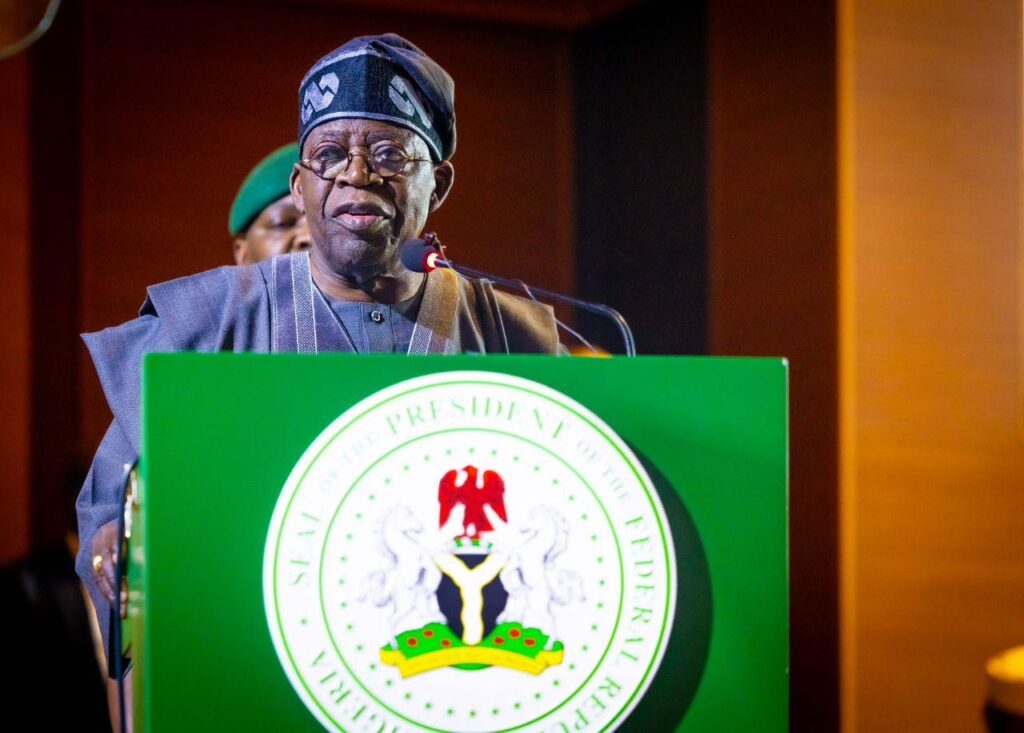
President Bola Ahmed Tinubu has provided an update on the Federal Government’s Renewed Hope Housing Agenda, outlining ongoing progress across multiple states and key reforms aimed at expanding access to affordable housing in Nigeria.
The President said the administration’s commitment to delivering 100,000 housing units nationwide is now being implemented through active construction projects in several regions, including major developments in Abuja, Lagos, and other parts of the country.
According to the update, over 3,000 housing units are currently under construction at Karsana in the Federal Capital Territory, while a 2,000-unit housing estate in Ibeju-Lekki, Lagos State, is at an advanced stage with sales already underway. Across the country, more than 15,000 housing units are reportedly in various stages of development.
Tinubu noted that the housing programme extends beyond construction, emphasizing reforms targeted at improving the entire housing value chain, including land administration, financing, and building infrastructure.
He highlighted ongoing efforts to formalize land ownership through improved titling systems in collaboration with the World Bank, aimed at reducing the volume of unregistered land and unlocking dormant economic value.
The administration has also introduced a strengthened equipment leasing framework to support developers and contractors, ensuring access to construction machinery and reducing project delays.
In addition, the government has introduced standardized pricing for federal housing units to improve transparency and eliminate unofficial costs, alongside the establishment of building materials hubs across all six geopolitical zones.
On financing, Tinubu revealed that through the MOFI Real Estate Investment Fund, 1,859 families across 25 states have accessed mortgages totaling ₦128 billion, with interest rates fixed at 9.75 per cent and repayment periods extending up to 20 years. The Family Homes Funds initiative also continues to support low-income households, including widows and vulnerable Nigerians.
The President acknowledged that Nigeria’s housing deficit remains significant, running into millions of units, but stressed that the sector is now being approached as a driver of economic growth rather than solely a welfare intervention.
He said the renewed focus connects housing development to job creation, manufacturing activity, and broader economic expansion.
Tinubu described the programme as a long-term national effort, noting that while progress is ongoing, the scale of the challenge requires sustained implementation over time.
Renewed Hope Housing, he said, represents a structural shift in Nigeria’s approach to real estate development, positioning home ownership as both a social goal and an economic engine.
