The United States has concluded its counterterrorism mission in Nigeria and withdrawn most of the military personnel deployed to support security operations in the Lake Chad Basin, marking the end of a temporary military deployment aimed at strengthening regional efforts against terrorist groups.
The withdrawal comes after the completion of a joint operation conducted in collaboration with Nigerian security forces. Although American troops have left the country, U.S. officials have emphasized that Washington remains committed to supporting Nigeria through intelligence sharing, military cooperation, and strategic security partnerships.
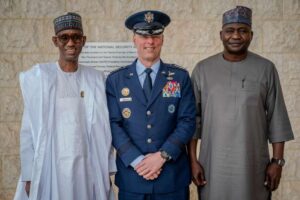
The announcement was made by General Dagvin R.M. Anderson, Commander of U.S. Air Forces in Europe–Air Forces Africa, during a virtual briefing following the African Chiefs of Defence Conference 2026. According to Anderson, the deployment achieved its primary objective of enhancing regional security while helping disrupt the operational network of the Islamic State (ISIS/Daesh) in West Africa and beyond.
He stated that close intelligence cooperation between the United States and Nigerian security agencies played a critical role in an operation that resulted in the elimination of Abu-Bilal Al-Minuki, described as a senior ISIS leader involved in coordinating the group’s international activities and recruitment efforts. U.S. officials said the operation demonstrated the effectiveness of intelligence-driven collaboration between both countries in tackling transnational terrorist threats.
The military deployment began earlier this year as part of ongoing efforts to strengthen Nigeria’s counterterrorism capabilities, particularly in the Lake Chad Basin, a region that has remained vulnerable to attacks by extremist groups for more than a decade. The mission focused on providing intelligence, surveillance, reconnaissance, and logistical support to Nigerian forces engaged in operations against terrorist organizations operating across northeastern Nigeria and neighboring countries.
According to U.S. officials, the deployment was never intended to become a permanent military presence in Nigeria. Instead, it was designed as a targeted mission with clearly defined objectives, allowing American personnel to support Nigerian-led operations while enhancing coordination among regional security partners.
Despite the withdrawal of troops, General Anderson stressed that the security partnership between Nigeria and the United States remains strong. He explained that future cooperation will focus on intelligence sharing, capacity building, advisory support, professional military education, and other forms of strategic engagement requested by the Nigerian government.
Security analysts have noted that the evolving partnership reflects a broader shift in U.S. security policy across Africa, where Washington increasingly emphasizes supporting local forces through intelligence, training, and technology rather than maintaining large troop deployments. This approach is intended to help African nations build sustainable security institutions capable of responding effectively to emerging threats.
Nigeria has for years remained one of the United States’ key security partners in West Africa due to its strategic importance and its central role in combating terrorism within the Lake Chad Basin. The country continues to face security challenges posed by insurgent groups, including factions linked to ISIS and Boko Haram, as well as banditry and other forms of violent extremism in different parts of the country.
The conclusion of the mission comes at a time when regional governments continue to intensify efforts to address cross-border security threats affecting Nigeria, Chad, Niger, and Cameroon. Terrorist groups operating within the region have exploited porous borders, making intelligence sharing and multinational cooperation essential components of counterterrorism operations.
While the withdrawal marks the end of the latest U.S. military deployment, officials from both countries have indicated that cooperation will continue through existing defence agreements and bilateral security initiatives. American authorities reiterated that they remain committed to working with Nigeria to improve regional stability, strengthen counterterrorism capabilities, and support long-term security objectives.
The development underscores the continued importance of international partnerships in addressing terrorism across the Lake Chad Basin. Although the presence of U.S. troops on Nigerian soil has ended, both governments maintain that their shared commitment to combating extremist violence remains unchanged, with future collaboration expected to focus on intelligence cooperation, technical assistance, and strategic security engagement rather than direct military deployment. Visit www.jocomms.com for more news.
